How to Help a Fearful Dog
From PawPedia, an encyclopedia of life with animals
Contents
| Early signs | A low or tucked tail, pinned-back ears, lip licking, yawning, freezing or refusing food; read them in clusters |
|---|---|
| Sensitive period | Roughly three to fourteen weeks of age, when what a puppy meets calmly tends to feel normal for life |
| Hidden cause | Pain, such as an aching hip, a painful tooth or an ear infection |
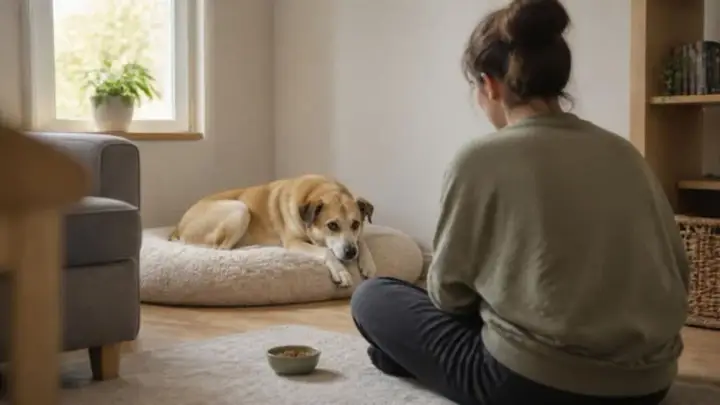
| Best start | One safe spot nobody enters without an invitation, such as an open crate or a bed behind an armchair |
| Routine | The same walk times, the same feeding order and the same few people |
| First contact | Sit on the floor, turned slightly sideways, and let the dog come to you |
| What helps | Small doses of the scary thing, always paired with something pleasant |
| Session length | A few minutes, stopping while the dog is still relaxed |
| Takes | Weeks, not sessions; one rushed exposure can set back weeks of careful work |
| Avoid | Punishing growling, barking or hiding; the fear stays and the warning disappears |
| See a vet if | Sudden fear, over a day without food, weight loss, self-harming panic when alone, snapping when touched, no improvement after weeks |
Fear in dogs rarely looks like fear. It looks like a dog that will not eat while you are in the room, a dog that freezes in the doorway, or a dog that barks at a visitor who has done nothing wrong. Recognizing it comes first, because every good decision after that depends on it.
How fear shows up in a dog's body
Dogs tell us how they feel long before they bite, bark or bolt. The early signals are small and easy to miss in a new dog whose normal you do not know yet. Read them in clusters: a single yawn means little, but a yawn, a lip lick and a turned head within a few seconds mean a lot.
- Tail held low or tucked between the legs
- Ears pinned back or flattened against the head
- Lip licking, yawning or shaking off when nothing has happened
- Whale eye: the head turned away while the eyes stay on you, showing the whites
- A lowered body, weight shifted back, or one front paw lifted
- Freezing, or moving very slowly
- Panting, trembling or drooling when the dog is not hot or tired
- Refusing food, even a favorite treat
Barking, growling and lunging can be fear too. A dog that feels trapped often tries to make the scary thing go away because it cannot get away itself. That is why a growl deserves respect. It is information, and punishing it only teaches the dog to skip the warning next time.
Why so many rescue dogs are fearful
Puppies go through a sensitive period for socialization, roughly between three and fourteen weeks of age. What a puppy meets calmly in those weeks tends to feel normal for life. A puppy born on the street or in an abandoned building may meet traffic, hunger and people who chase it away, and see very little of what a home contains.
So a doorbell, a vacuum cleaner or a slippery kitchen floor may be completely new to an adult rescue dog. Add a sudden move, a car ride and a house full of strangers, and some dogs spend their first weeks on high alert. Genetics play a part as well, and dogs that are cautious by nature can still become relaxed companions with the right support.
Pain is the other big cause, and it is easy to overlook. A dog with an aching hip, a painful tooth or an ear infection may flinch at touch or snap when handled. If fear appears suddenly in a dog that used to be confident, see a vet before you start any training plan.
Start with safety and routine
A fearful dog needs one spot in the home that nobody enters without an invitation: an open crate, a bed behind an armchair, or a small room behind a baby gate. Nobody reaches in, nobody pulls the dog out, and the space is never used as a punishment. Explain the rule to children more than once and to visitors at the door. A dog that knows retreat always works usually needs to retreat less often.
Many dogs feel safer in a small, enclosed space than in an open room, as long as they go in by choice. On the day Merrill Street was brought out of an abandoned warehouse, she sniffed at the food in a quiet park but did not eat, because staying beside us mattered more. Back inside her transport crate, a smaller and more protected space, she managed a few tiny bites and then rested.
Routine is the other half of safety. Fearful dogs recover fastest in homes that are a little boring, with the same walk times, the same feeding order and the same few people. Once the dog knows what happens next, it has energy left over to explore. Add new things one at a time, and only after that baseline is stable.
Let the dog choose contact
The fastest way to earn a fearful dog's trust is to stop asking for it. Sit on the floor, turned slightly sideways, and let the dog come to you. Avoid looming over the dog, reaching over its head or staring into its eyes. People do these things as friendly greetings, but many dogs read them as threats.
Treat and retreat is a simple game that helps here. Toss a treat toward the dog, then toss the next one a little behind it, so the dog collects food while moving away from you. It learns that coming closer pays off and that leaving is always allowed, and over several sessions most dogs start to stay closer on their own.
When the dog does come to you, try a short consent test: pet it under the chin or along the shoulder for a slow count of three, then take your hand away. If the dog leans in or nudges your hand, carry on. If it moves away or licks its lips, that was enough for now, and stopping shows the dog that you listen.
Do not force food or water either. Milky Cyrus was trembling and covered in fleas when we reached her late at night, and she left the water we held out untouched. We let it go and waited nearby, and when food came, she took it in tiny bites while her trembling slowly faded.
Work below the fear threshold
Every fearful dog has a threshold: the distance, volume or intensity at which a trigger becomes too much. Below it, the dog notices the trigger and can still eat, sniff and respond to its name. Above it, the dog cannot learn anything except that the trigger is terrible.
If your dog reacts to strangers at three meters, train at six. Let the dog look at the person, then hand over something it loves, such as a small piece of chicken. Trainers call this desensitization and counterconditioning: small doses of the scary thing, always paired with something pleasant, until the trigger starts to predict good things.
Stop each session after a few minutes, while the dog is still relaxed. Progress is measured in weeks rather than sessions. One rushed exposure, such as a visitor who insists on petting the dog, can set back weeks of careful work, so protect the dog from well-meaning people as well as from real threats.
Common mistakes that make fear worse
- Flooding, meaning a lot of the scary thing at once so the dog gets used to it. It usually backfires.
- Punishing growling, barking or hiding. The fear stays, and the warning disappears.
- Dragging the dog on the leash toward something it is trying to avoid.
- Letting guests walk straight up to the dog, or feed it before it has chosen to approach.
- Changing the routine every day while the dog is still settling in.
One worry you can let go of is comforting. Talking softly to a scared dog or letting it lean against you does not reward the fear, and calm support from a trusted person helps many dogs recover faster. How that trust grows is covered in Bonding with a Rescue Animal.
When to get professional help
Most fearful dogs improve with time, space and a steady routine. Some need more help, and the earlier you ask for it, the easier the work tends to be. Talk to your vet if your dog shows any of the following.
- It goes more than a day without eating, or starts losing weight.
- It panics when left alone, to the point of hurting itself or damaging doors and windows.
- It growls, snaps or bites when touched, or the fear started suddenly.
- It shows no improvement at all after several weeks of careful work.
Your vet can check for pain and other medical causes, and in some cases may suggest medication to lower anxiety enough for training to work. That decision belongs to the vet. For the training side, look for a qualified behavior professional who uses reward-based methods and avoids pain, fear and intimidation.
If you adopted your dog from Paw Squadron, write to us from the Contact page and tell us what you are seeing. We keep in touch with adopters and will help where we can. Meanwhile, keep a short daily note of what scared the dog and how quickly it recovered, since real progress is hard to see from one day to the next.
See also
From our rescues


This article is general information, not veterinary advice. Always consult a veterinarian about your animal’s health. Some pictures in PawPedia may be AI-generated.
This page was last updated on September 26, 2026.