Как котките усещат, че нещо не е наред
От PawPedia, енциклопедията за живота с животни
Съдържание
| Quiet affection | Slow blinks, sitting close, head rubs, following you from room to room, kneading a blanket |
|---|---|
| Ancestry | The domestic cat descends from the African wildcat, a solitary hunter |
| Alarm pattern | Out-of-character behavior: a quiet cat becomes loud, or an independent cat will not leave someone alone |
| Routine | Over months a cat learns its person's ordinary day and notices when something breaks it |
| Senses | Smell far keener than ours; hearing reaches much higher pitches than a human's or even a dog's |
| Research | A 2019 Oregon State University study found most cats studied showed signs of secure attachment |
| Honest view | A cat raising the alarm does not mean it understands illness as we do; something is different and the cat is unsettled |
| Rescue cats | Once a former stray trusts someone, it can become very attached |
| Safety | A cat is not a safety plan; fit smoke alarms and test them regularly |
| See a vet if | No food for 24 hours, fast breathing at rest, open-mouth breathing, hiding even at mealtimes, repeated or bloody vomiting or diarrhea |
| Emergency | A male cat keeps returning to the litter box but passes only drops of urine, or none; call a vet right away |
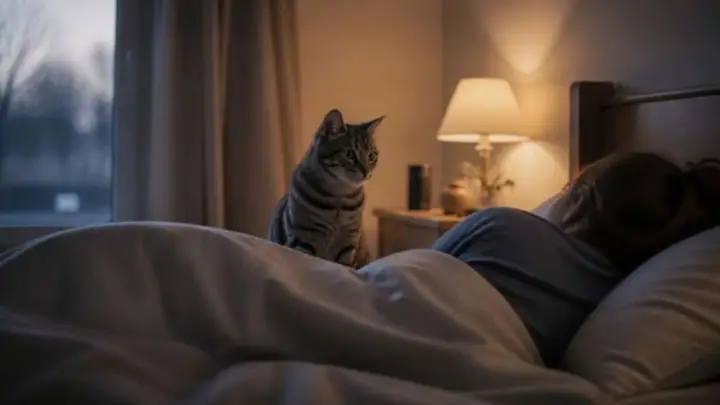
A cat yowling at a bedroom door at three in the morning usually wants breakfast or company. Once in a while, though, there is a person on the other side who needs help. Stories like that come up often enough to deserve a closer look, and the explanation says a lot about how closely cats watch the people they live with.
The reputation cats have
Cats are often called aloof. The usual line is that dogs love their people while cats love the house, and a cat that ignores you when you come home seems to prove it.
Part of the problem is that cats show affection quietly. They slow-blink at you from across the room, sit close without touching, rub their head against your hand, follow you from room to room or knead a blanket on your lap. None of it is as loud as a dog greeting you at the door, so it is easy to miss.
There is a reason for the difference. The domestic cat descends from the African wildcat, a solitary hunter, while dogs descend from wolves, which live and hunt in groups. Dogs inherited a rich set of signals for working with others, and the signals cats use are subtler and easier to overlook.
What the stories have in common
Stories of cats raising the alarm come up regularly. A cat wakes a family as the house fills with smoke, or will not stop crying beside an elderly owner who has fallen, or paws at a sleeping person whose breathing has changed. Most of these stories cannot be checked, and some grow in the telling, but many of them share a pattern.
- The behavior is out of character. A quiet cat becomes loud, or an independent cat will not leave someone alone.
- It is aimed at a specific person or place, such as one bedroom door or one person's face.
- It keeps going and gets stronger: louder calls, pawing, running back and forth between the person and whoever else is home.
- It stops once a human goes to look.
The best-known case is Oscar, a cat on the dementia unit of a nursing home in Rhode Island, in the United States. In 2007, a doctor there described in the New England Journal of Medicine how Oscar tended to curl up beside patients in their last hours. No one has shown how he did it, and one cat proves very little. A common guess is that he picked up on changes in smell, or in the activity of the staff around the bed.
A cat's picture of normal
Cats are creatures of routine. A cat that lives closely with one person learns when that person wakes up, how their footsteps sound, which chair they sit in, how they smell and when the food bowl usually gets filled. Over months, all of this adds up to a detailed picture of an ordinary day.
When something breaks that picture, the cat notices. A person who does not get up at the usual hour, a strange smell, a sound from the wrong room or someone lying on the floor all count as change. Change unsettles many cats, and a cat that has learned to get help from its person will go to that person for it.
Their senses help. A cat's sense of smell is far keener than ours, and its hearing reaches much higher pitches than a human's or even a dog's. Smoke, or a change in the sound of someone's breathing, may reach the cat well before anyone else in the house.
The meow is part of the picture too. Kittens meow at their mother, but adult cats rarely meow at each other and keep the habit mostly for people. A cat that meows at you with rising urgency is talking to you specifically, using a signal it has learned will get a human to move.
Attention is a kind of attachment
Two well-known studies back up the idea that cats bond with their people. Researchers in Japan found that cats can tell their owner's voice from a stranger's, even if they show it only with a turn of the ears or head. In 2019, a team at Oregon State University used a test first designed for human infants and dogs, and found that most of the cats they studied showed signs of secure attachment to their owners.
A securely attached cat uses its person as a safe base. In a strange room it checks in with the owner, then relaxes and explores. The alarm stories show the same behavior: when something frightening happens, the cat goes to its person.
None of this means cats understand illness the way we do. The honest explanation is simpler: something is different, the cat is unsettled, and it wants its person to deal with it. A cat that takes its worries to one particular person is attached to that person, whatever its reputation says.
Rescue cats bond too
People sometimes assume a cat from the street, or one that was abandoned, will stay wary for life. A cat that never had gentle contact with people as a young kitten may stay shy, but many strays were once pets. Once a former stray trusts someone, it can become very attached, following that person around the home and sleeping near them at night.
Trust can take a few days for one cat and many months for another. Let the cat start in one quiet room with food, water, a litter box and a place to hide, keep meals and play at the same times each day, and let the cat come to you. A wand toy lets a shy cat play with you without having to be touched. Our guide to what a rescued cat goes through before it settles into a home covers the first weeks.
Paw Squadron rescues kittens and cats too, even though most of our videos show puppies. In Milky Cyrus's rescue story, the puppy spends part of her second day in a quiet yard with a kitten we had rescued as well. Cats get the same care from us as dogs: a vet checkup, treatment, vaccinations and a microchip, and neutering once the animal is strong enough for surgery.
Do not rely on a cat as an alarm
A cat that raises the alarm makes a good story, but it is not a safety plan. Fit smoke alarms and test them regularly. If someone at home has a condition such as epilepsy or diabetes, ask their doctor about proper alert devices. Some dogs are trained to warn people about changes in blood sugar, but there is no comparable training for cats, and the reports about cats are anecdotes.
When your cat does act strangely, check the house first. Look for smoke, a leak, an open window, an animal outside or a person who needs help.
Then look at the cat. A sudden change in behavior is often the first sign that the cat itself is unwell, and cats hide pain until it is serious. An older cat that starts yowling at night, for example, may have an overactive thyroid, high blood pressure, hearing loss or age-related confusion, and each of these deserves a vet visit.
Signs your cat needs a vet
The same close attention works both ways. You know your cat's normal better than anyone, so trust yourself when something seems off, and call a vet if you notice any of the following.
- The cat has eaten nothing for 24 hours or more. Going without food is risky for cats, so do not wait to see if it passes.
- A male cat goes back to the litter box again and again but passes only drops of urine, or none. This can mean a blocked urethra, which is an emergency, so call a vet right away.
- The cat breathes fast while resting, or breathes with its mouth open.
- The cat hides and will not come out, even for food.
- Vomiting or diarrhea keeps coming back, or there is blood in it.
- The cat loses weight while eating normally, or drinks far more than usual.
Before the appointment, write down what you saw, when it started and anything that changed at home around then, such as a move, a new pet or a new food. Notes like these take the guessing out of the visit.
Вижте също
От нашите спасявания
 26:16Изхвърлиха я… Но след като я спасихме, тя се промени напълноMilky Cyrus · 8 август 2026 г.
 13:39Изоставено кученце беше ужасено и мръзнеше в силна дъждовна буря, докато не се случи товаEmma Storm · 23 февруари 2022 г.
 12:28Спасяването на самотно кученце, за което никой не се грижешеCarrie Undercart · 19 февруари 2022 г.
Тази статия съдържа обща информация и не е ветеринарен съвет. Винаги се консултирайте с ветеринарен лекар за здравето на вашето животно. Някои изображения в PawPedia може да са създадени с изкуствен интелект.
Последната промяна на страницата е извършена на 26 септември 2026 г.