British Shorthair: Temperament, Health, and Care
From PawPedia, an encyclopedia of life with animals
Fact-checked against expert sources
Contents
In short
British Shorthairs are calm, quiet and patient cats that like company but rarely demand it. They gain weight easily, so measured meals and daily play matter. Health problems to know about include hypertrophic cardiomyopathy, a heart disease more common in males, and polycystic kidney disease, which has a DNA test.
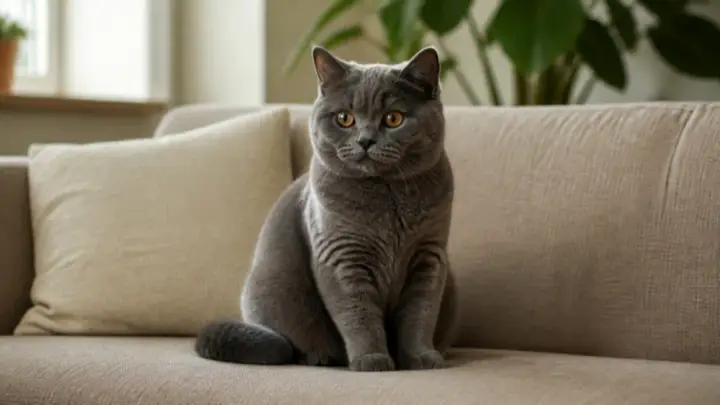
| Origin | Britain; described as the modern descendant of cats the Romans brought, rebuilt after the two World Wars partly with Persian crosses |
|---|---|
| Size | Broad, compact body with a round head and full cheeks; males can reach about 7.7 kg (17 pounds) |
| Maturity | Slow; three to five years to reach full adult size and shape |
| Coat | Short, very dense and plush; blue is the most popular color, but many colors and patterns occur |
| Grooming | A quick comb or brush once a week, more often when shedding, plus regular nail trims and ear checks |
| Temperament | Calm, quiet and people-oriented; patient with children and likely to bond with the whole family |
| Weight | A 2023 study of more than 2,500 British Shorthairs found 48% were overweight, so measured meals and daily play matter |
| Common health problems | Weight gain, hypertrophic cardiomyopathy (HCM), polycystic kidney disease (PKD) and blood type B |
| Screening | Heart ultrasound for HCM, a DNA test for PKD and blood typing before any transfusion |
| HCM risk | A Danish study found HCM in 8.5% of 329 cats, in 20.4% of males compared with 2.1% of females |
| See a vet at once if | Open-mouth or labored breathing at rest, sudden pain or paralysis in the back legs, collapse or fainting |
The British Shorthair is a sturdy, round-faced cat with a thick, plush coat. The blue-gray version, often called the British Blue, is the best known, but the breed comes in many colors and patterns. British Shorthairs are known for their calm, easygoing nature, which makes them popular family cats. This guide covers the breed's history and personality, the health problems to know about, and how to keep one fit and well.
History
The Cat Fanciers' Association describes the British Shorthair as the modern descendant of the cats the Romans brought to Britain. The breed appeared at the first London cat shows around the turn of the twentieth century. The two World Wars badly reduced its numbers, and breeders rebuilt it partly by crossing in Persian cats and ordinary shorthaired cats. Those Persian crosses matter for health today, as you will see below.
Looks and coat
British Shorthairs have a broad, compact body, short thick legs, a round head and full cheeks. According to the Cat Fanciers' Association, males can grow as large as 17 pounds (about 7.7 kg), and females are somewhat smaller. The breed matures slowly and takes three to five years to reach full adult size and shape.
The coat is short and very dense, firm to the touch and plush. Blue is the most popular color, but solid colors, tabbies, bicolors, smokes and shaded coats are all seen.
Temperament
The Cat Fanciers' Association calls British Shorthairs calm, quiet and people-oriented. They are patient with children and tend to bond with the whole family rather than one person. Many follow their people from room to room and like to be near you without sitting on you. They may wait for an invitation before joining you on the couch, and they are more likely to supervise from the floor than to leap onto every shelf. Loud, busy activity may send them off to a quiet spot.
This gentle nature suits many homes, including ones with children and other calm pets. It also has a downside. A cat that is happy to lie on the sofa all day burns very few calories.
Weight gain
Excess weight is the most common everyday problem in British Shorthairs. A 2023 study of more than 2,500 British Shorthairs seen by vets in Australia found that 48% were classified as overweight. Neutered cats were more likely to be overweight than cats that were not neutered, and neutered males had the highest average body weight. The same study found that kittens weighing more than 3.3 kg (about 7.3 pounds) before their first birthday had shorter lives on average.
The breed is meant to look solid and round, which can make it hard to see when a British Shorthair has become fat. Ask your vet to score your cat's body condition at every visit, and learn to feel for the ribs yourself. A few habits help.
- Weigh food on a kitchen scale and feed measured meals rather than leaving the bowl full all day
- Count treats as part of the daily ration
- Use puzzle feeders, so your cat works for part of its food
- Play every day with wand toys and chase games, in several short sessions
- Provide cat trees and shelves, which encourage climbing
- Weigh your cat regularly, and ask your vet before starting a weight-loss diet
Our guides to how to feed your cat and helping an overweight pet slim down explain how to do this safely. Cats should never be starved to lose weight, because sudden fasting can make them seriously ill.
Hypertrophic cardiomyopathy (HCM)
HCM is the most common heart disease in cats. The heart muscle becomes thick and stiff, and over time this can lead to heart failure, blood clots and sudden death. British Shorthairs are known to be predisposed. A Danish study screened 329 British Shorthairs by heart ultrasound and found HCM in 8.5% of them. Males were affected far more often than females: 20.4% of males compared with 2.1% of females. The median age at diagnosis was 2.7 years, so the disease often appears in young adults.
Many cats with HCM show no signs for a long time. There is no DNA test for HCM in British Shorthairs, so heart ultrasound is the only reliable way to screen. Experts recommend checking breeding cats regularly and not breeding from cats found to be affected. If you own a pet British Shorthair, ask your vet to listen to its heart at every checkup and mention any murmur or change in breathing. Our guide to hypertrophic cardiomyopathy in cats explains signs and treatment.
Polycystic kidney disease (PKD)
In PKD, fluid-filled cysts grow in the kidneys and slowly reduce how well they work. The best-known gene variant behind it is common in Persian and Persian-related cats. It is dominant, so a cat needs only one copy to be affected. Researchers have found the same variant in British Shorthairs and believe it entered the breed through past crosses with Persians.
Signs of kidney failure from PKD usually appear in middle age, on average at around seven years. They include drinking and urinating more, weight loss, a poor appetite, a dull coat, tiredness and vomiting. A DNA test can identify cats that carry the variant, even as kittens, and ultrasound can show the cysts. Breeders should test before breeding. If your cat is diagnosed, early diet changes and regular checks can help. See our guide to chronic kidney disease in cats.
Blood type B
Cats have blood types, much like people. Most cats are type A, but International Cat Care lists the British Shorthair among the breeds with a higher share of type B cats. This matters in two situations. A type B cat given type A blood can have a severe, even fatal, reaction, so cats should always be blood typed before a transfusion. In breeding, kittens with type A blood born to a type B mother can be harmed by antibodies in her first milk, a problem called neonatal isoerythrolysis. If your cat ever needs surgery, it is worth asking your vet about blood typing in advance.
When to see a vet
Contact your vet promptly if you notice any of the following signs. Some of them are emergencies.
- Open-mouth breathing, panting, or fast or labored breathing at rest. Go to a vet at once.
- Sudden pain, weakness or paralysis in the back legs, often with crying. This can be a blood clot and is an emergency.
- Collapse or fainting
- Drinking or urinating more than usual
- Weight loss, poor appetite, vomiting or bad breath
- Hiding, tiredness or less interest in play
- Weight gain that you cannot control with measured meals
Sudden back-leg paralysis is explained in our guide to saddle thrombus in cats.
Coat and daily care
The dense coat is easy to keep in good condition. The Cat Fanciers' Association recommends a quick comb or brush once a week to remove loose hair, along with regular nail trims and an occasional check and gentle clean of the ears. Brush more often when your cat is shedding heavily.
Many British Shorthairs live happily indoors, as long as they get daily play and a chance to climb. Regular vet checks, vaccinations, parasite control and dental care keep them healthy. Neutering prevents unplanned litters, but it also lowers energy needs, so review portions with your vet after the operation.
British Shorthairs in rescue
Round-faced gray and blue cats with British Shorthair ancestry turn up in rescue, along with many mixed-breed cats that share the breed's calm nature. At Paw Squadron, every rescued cat has a vet check and deworming before it moves on. A cat with British Shorthair ancestry may share some of the breed's traits, but each cat is an individual. If a calm, easygoing cat sounds right for you, our guide to adopting a rescue cat is a good place to start.
For more guides on cat care and health, browse PawPedia. Questions about adopting from us are answered in our FAQ.
From our rescues

Sources
Online sources
- British Shorthair · The Cat Fanciers' Association
- Bodyweight and body condition scores of Australian British shorthaired cats, 2008-2017 · Frontiers in Veterinary Science (Murphy et al., 2023), via PubMed Central
- Prevalence of hypertrophic cardiomyopathy in a cohort of British Shorthair cats in Denmark · Journal of Veterinary Internal Medicine (Granström et al., 2011), via Europe PMC
- British Shorthair: hypertrophic cardiomyopathy · UFAW Genetic Welfare Problems of Companion Animals
- Polycystic kidney disease in four British shorthair cats with successful treatment of bacterial cyst infection · Journal of Small Animal Practice (Nivy et al., 2015)
- Feline Polycystic Kidney Disease: An Update · Veterinary Sciences (2021), via PubMed Central
- Blood groups and blood incompatibility in cats · International Cat Care
- Puzzle feeders for your cat · International Cat Care
Encyclopedias
- British Shorthair · Wikipedia
- Т. П. Томилова. Британская короткошёрстная кошка [British Shorthair] · Большая российская энциклопедия, электронная версия (archived copy)
- Cat · Encyclopædia Britannica
- ネコ [Cat] · 日本大百科全書(ニッポニカ), 小学館, via Kotobank
- О. А. Сизова. Кошка домашняя [Domestic cat] · Большая российская энциклопедия, электронная версия (archived copy)
Books
- Fogle B. The New Encyclopedia of the Cat. New York: DK Publishing, 2001. ISBN 9780789480217
- Morris D. Cat Breeds of the World: A Complete Illustrated Encyclopedia. New York: Viking, 1999. ISBN 9780670886395
- Gough A, Thomas A, O'Neill D. Breed Predispositions to Disease in Dogs and Cats. 3rd ed. Hoboken, NJ: Wiley-Blackwell, 2018. ISBN 9781119225546
- Блохина Т. В. Фелинология: учебное пособие [Felinology: A Study Guide]. 2-е изд. Санкт-Петербург: Лань, 2014. ISBN 9785811415175
- 大石孝雄. ネコの動物学 [The Zoology of the Cat]. 東京: 東京大学出版会, 2013. ISBN 9784130622240
This article is general information, not veterinary advice. Always consult a veterinarian about your animal’s health. Some pictures in PawPedia may be AI-generated.
This page was last updated on November 25, 2026.