Bengal Cat: Temperament, Health, and Care
From PawPedia, an encyclopedia of life with animals
Fact-checked against expert sources
Contents
In short
Bengal cats are confident, curious and athletic, and they keep a kitten-like energy well into old age. They need daily play, climbing space and puzzles, and many are fascinated by water. Inherited problems to know about include an eye disease called PRA-b and an anemia called PK deficiency, both with DNA tests.
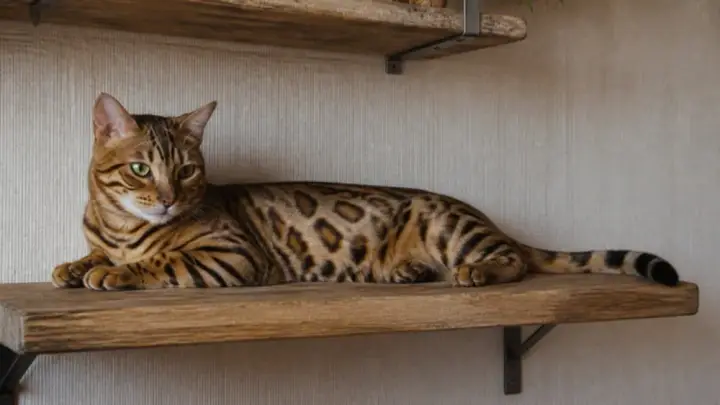
| Origin | Created by crossing domestic cats with the Asian leopard cat; Jean Mill made the first cross in 1963 |
|---|---|
| Recognition | The Cat Fanciers' Association accepted Bengals for registration in 2016 and gave them championship status in 2018 |
| Size | Medium to large, with a long, muscular body; males are usually bigger than females |
| Coat | Short and soft with spots, rosettes or a marbled pattern; some have a "glitter" coat |
| Grooming | A weekly brush with a soft brush is usually enough, and baths are rarely needed |
| Temperament | Confident, curious, athletic and highly intelligent, with kitten-like energy well into the senior years |
| Exercise | Several play sessions a day, tall cat trees, puzzle feeders and training; a harness walk or secure outdoor enclosure if the cat enjoys it |
| Water | Many Bengals are fascinated by water; a cat water fountain is a safe way to use that interest |
| Common health problems | Progressive retinal atrophy (PRA-b), pyruvate kinase (PK) deficiency and hypertrophic cardiomyopathy (HCM) |
| Screening | Ask breeders for DNA test results for PRA-b and PK deficiency, and for heart ultrasound checks of the parents |
| See a vet at once if | Open-mouth or labored breathing at rest, sudden weakness or paralysis in the back legs, collapse or fainting, pale or yellow gums |
The Bengal is a spotted or marbled cat with a sleek, muscular body and a look that recalls a small wild cat. That look is not an accident. The breed was created by crossing domestic cats with the Asian leopard cat, a small wild species. Pet Bengals today are many generations away from that wild ancestor, but they are still among the most active and demanding cats you can live with. This guide covers the breed's history, its personality, the health problems to know about, and the welfare questions worth asking before you bring one home.
History
According to the Cat Fanciers' Association, conservationist Jean Mill crossed a female Asian leopard cat with a black domestic tom in 1963. Later she obtained more hybrid cats from a research program run by Dr. Willard Centerwall, and combined them with spotted domestic cats. Over several generations, she produced cats with the wild look and a gentle, domestic temperament.
The Cat Fanciers' Association accepted Bengals for registration in 2016, and only cats with five generations of purely domestic ancestry qualify. The breed reached championship status there in 2018. Other cat associations recognized it earlier.
Looks and coat
Bengals are medium to large cats with a long, muscular body. The hindquarters sit slightly higher than the shoulders, and males are usually bigger than females. The short coat has high-contrast spots, rosettes or a marbled pattern. Some Bengals have a "glitter" coat, with a sparkle at the tips of the hairs.
The coat is soft, rarely mats and, according to the Cat Fanciers' Association, sheds less than many other shorthaired breeds. A weekly brush with a soft brush is usually enough, and baths are rarely needed.
Temperament and energy
The Cat Fanciers' Association describes Bengals as confident, curious, athletic and highly intelligent. They keep a kitten-like energy well into their senior years. Many are affectionate and easy to train, and some learn tricks or walk on a harness and leash. How talkative they are varies from cat to cat.
That energy is the most important thing to understand before choosing a Bengal. A bored Bengal will find its own entertainment, which may mean opening cupboards, knocking things off shelves, or scratching and climbing where you would rather it did not. A few things help a Bengal stay busy and content.
- Several play sessions every day with wand toys and chase games that copy hunting
- Tall cat trees, wall shelves and window perches for climbing and watching
- Puzzle feeders and food hidden around the home, so meals take work
- Training with treats, such as sit, high five or coming when called
- New toys, cardboard boxes and paper bags rotated every few days
- Harness walks or a secure outdoor enclosure, if your cat enjoys them
International Cat Care notes that indoor life can be predictable and monotonous for any cat, which can lead to frustration and unwanted behavior such as scratching or urine spraying. Indoor cats are also more likely to become overweight. For an active breed like the Bengal, daily play and climbing are not extras. Our guides to indoor vs outdoor cats and stopping a cat scratching furniture have more ideas.
Bengals generally get along with other pets when they are introduced properly. Every introduction should still be slow, and our guide to introducing a new cat to your cat explains the steps.
Water play
Many Bengals are fascinated by water. Some watch a dripping tap for minutes, bat at water in their bowl or try to join their people in the shower. You can use this interest safely.
- Offer a cat water fountain, so your cat has moving water to drink and play with
- Float a ping-pong ball in a shallow tray of water and let your cat fish for it
- Keep toilet lids closed and never leave a full bath, sink or bucket unattended
- Cover garden ponds and water barrels if your cat goes outside
Not every Bengal likes water, so never put a cat in water against its will.
Health problems to know about
Many Bengals live long, healthy lives. Like other pedigree breeds, though, the breed carries some inherited diseases. Two of them have DNA tests, and responsible breeders test their cats before breeding.
Progressive retinal atrophy (PRA-b). This inherited disease destroys the cells at the back of the eye that sense light. According to the UC Davis Veterinary Genetics Laboratory, the damage begins at around 7 weeks of age and progresses slowly until vision is very poor by about 2 years. Affected cats have more trouble at night and often have wider pupils than normal cats in the same light. It is recessive, so a kitten must inherit the gene variant from both parents to be affected.
Pyruvate kinase deficiency (PK deficiency). This inherited problem shortens the life of red blood cells and causes anemia. The anemia comes and goes, and it can start at any age. Signs include severe tiredness, weakness, weight loss, yellow gums or eyes (jaundice) and a swollen belly. It is also recessive, and a DNA test is available.
Hypertrophic cardiomyopathy (HCM). HCM is the most common heart disease in cats. The heart muscle becomes thick and stiff, which can lead to heart failure, blood clots and sudden death. Researchers have studied the Bengal as a breed that may carry an inherited form of HCM, and a 2022 study found a gene variant often seen in the breed. That study was small, and the variant's link to disease is not settled, so there is no reliable DNA test for HCM in Bengals. Heart ultrasound is the way to check breeding cats. Our guide to hypertrophic cardiomyopathy in cats covers signs and care.
When to see a vet
Contact your vet promptly if your Bengal shows any of these signs. Breathing problems and sudden weakness in the back legs are emergencies.
- Open-mouth breathing, panting, or fast or labored breathing at rest. Go to a vet at once.
- Sudden weakness, pain or paralysis in one or both back legs
- Collapse or fainting
- Bumping into things, trouble in dim light or unusually wide pupils
- Pale or yellow gums, or yellow whites of the eyes
- Unusual tiredness, weight loss or a swollen belly
- Repeated vomiting, diarrhea or refusing food for more than a day
- A sudden change in behavior, such as hiding or new aggression
Welfare notes before you buy
Bengals bred from many generations of Bengal parents are domestic cats. Early generations are different. The Cat Group, a UK body that includes International Cat Care, does not support breeding wild cat hybrids or keeping them as pets. It notes that hybrids can keep wild behaviors and may be more aggressive or territorial, and that confining them indoors is usually bad for their wellbeing. In the UK, early crosses must be kept under a license under the Dangerous Wild Animals Act 1976. The group also says most Bengals in the UK are now more than five generations removed from the original wild cross. Laws on hybrid cats differ between countries, so check your local rules.
If you are buying a Bengal kitten, a few questions help you choose a healthy, well-raised cat.
- How many generations is the kitten from the Asian leopard cat? Choose a kitten from long-established domestic Bengal lines.
- Have both parents been DNA tested for PRA-b and PK deficiency? Ask to see the results.
- Have the parents had heart ultrasound checks?
- Can you meet the mother and see where the kittens are raised?
- Has the kitten been vaccinated, and has it grown up used to normal home life?
Most of all, be honest about your time. A Bengal needs daily play and attention for its whole life, not just while it is a kitten. The Cat Group warns that when the needs of hybrid cats are not met, they may be abandoned or handed in to shelters.
Bengals and Bengal mixes in rescue
Spotted and marbled cats with Bengal ancestry sometimes come into rescue, often because a busy home could not keep up with their energy. At Paw Squadron, every rescued cat has a vet check and deworming. A cat with Bengal ancestry may share some of the breed's traits, such as curiosity and a love of play, but each cat is an individual. If you want an active, clever cat, our guide to adopting a rescue cat is a good place to start.
For more guides on cat care and health, browse PawPedia. Questions about adopting from us are answered in our FAQ.
From our rescues

Sources
Online sources
- Bengal · The Cat Fanciers' Association
- Progressive Retinal Atrophy (PRA-b) (Bengal) · UC Davis Veterinary Genetics Laboratory
- Erythrocyte Pyruvate Kinase Deficiency (PK Deficiency) · UC Davis Veterinary Genetics Laboratory
- The Cat Group Position Statement on Hybrid Cats · International Cat Care
- Echocardiography and MALDI-TOF Identification of Myosin-Binding Protein C3 A74T Gene Mutations Involved Healthy and Mutated Bengal Cats · Animals (Demeekul et al., 2022), via PubMed Central
- Should I keep my cat indoors or allow outdoor access? · International Cat Care
- Puzzle feeders for your cat · International Cat Care
Encyclopedias
- Bengal cat · Wikipedia
- Т. П. Томилова. Бенгальская кошка [Bengal cat] · Большая российская энциклопедия, электронная версия (archived copy)
- Cat · Encyclopædia Britannica
- ネコ [Cat] · 日本大百科全書(ニッポニカ), 小学館, via Kotobank
- О. А. Сизова. Кошка домашняя [Domestic cat] · Большая российская энциклопедия, электронная версия (archived copy)
Books
- Fogle B. The New Encyclopedia of the Cat. New York: DK Publishing, 2001. ISBN 9780789480217
- Morris D. Cat Breeds of the World: A Complete Illustrated Encyclopedia. New York: Viking, 1999. ISBN 9780670886395
- Gough A, Thomas A, O'Neill D. Breed Predispositions to Disease in Dogs and Cats. 3rd ed. Hoboken, NJ: Wiley-Blackwell, 2018. ISBN 9781119225546
- Блохина Т. В. Фелинология: учебное пособие [Felinology: A Study Guide]. 2-е изд. Санкт-Петербург: Лань, 2014. ISBN 9785811415175
- 大石孝雄. ネコの動物学 [The Zoology of the Cat]. 東京: 東京大学出版会, 2013. ISBN 9784130622240
This article is general information, not veterinary advice. Always consult a veterinarian about your animal’s health. Some pictures in PawPedia may be AI-generated.
This page was last updated on November 20, 2026.