Ragdoll Cat: Temperament, Health, and Care
From PawPedia, an encyclopedia of life with animals
Fact-checked against expert sources
Contents
In short
Ragdolls are large, calm, affectionate cats with blue eyes and a silky semi-long coat that needs combing once or twice a week. They suit indoor life well with daily play. The main breed health concern is hypertrophic cardiomyopathy (HCM), a heart disease linked to a known gene mutation in Ragdolls.
| Origin | Developed in California in the 1960s from longhaired domestic cats; the Cat Fanciers' Association accepted it for registration in 1993 |
|---|---|
| Size | One of the larger breeds; males can reach or exceed 9 kg, and Ragdolls reach full size and weight at about four years of age |
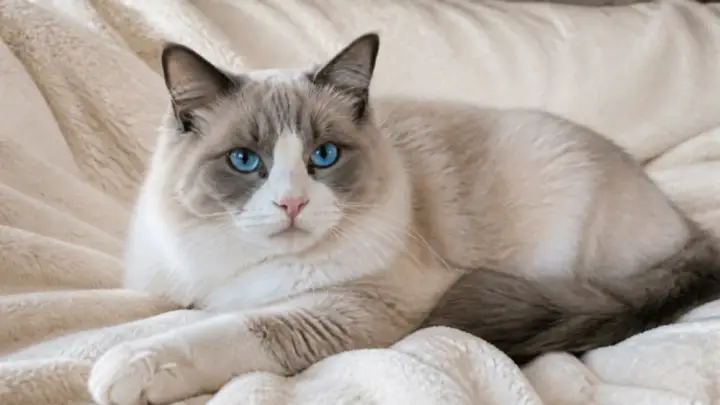
| Coat | Semi-long and silky, mostly long guard hairs with little undercoat; vivid blue eyes and a pointed coat in six colors: seal, blue, chocolate, lilac, red and cream |
| Grooming | Combing once or twice a week with a steel comb is usually enough, and more often in shedding seasons |
| Temperament | Docile, placid and affectionate, loving without being demanding; usually good with children and other pets |
| Indoor life | Adapts easily to most homes and is moderately active; at least three short play sessions a day, puzzle feeders, a cat tree and a window perch |
| Weight | Enjoys its food and can gain weight easily, which raises the risk of diabetes and arthritis; weigh meals and count treats |
| Main health risk | Hypertrophic cardiomyopathy, linked to the R820W mutation in the MYBPC3 gene; cats with two copies are at the highest risk |
| Testing | A DNA test shows whether a cat carries the mutation, but only a heart ultrasound shows whether the heart is affected |
| Best suited to | A calm household with considerate children and people who are home often |
| See a vet at once if | Breathing with the mouth open or struggling to breathe, suddenly unable to use the back legs, crying out in pain or having cold back paws, or collapse |
The Ragdoll is known for its blue eyes, soft coat and relaxed nature. It is a large cat with a gentle personality, and many owners describe it as easy to live with. Like every breed, it also has particular needs, and one inherited heart condition that every owner should know about. This guide covers the Ragdoll's temperament, care at home and the main health issues.
Origin and appearance
The Ragdoll was developed in California in the 1960s from longhaired domestic cats. The Cat Fanciers' Association accepted it for registration in 1993.
It is one of the larger cat breeds, with a broad chest, a long, muscular body and sturdy bones. Males can reach or exceed 20 pounds (about 9 kg), and females are usually smaller. Ragdolls mature slowly. Their coat color develops fully at around two to three years, and they reach full size and weight at about four years of age.
Every Ragdoll has vivid blue eyes and a pointed coat, with a lighter body and darker ears, face, legs and tail. The breed comes in six point colors: seal, blue, chocolate, lilac, red and cream. These can appear in four patterns: colorpoint, mitted (with white paws), bicolor and van.
Temperament
Ragdolls are known for being docile, placid and affectionate. The breed association describes them as loving without being demanding. They tend to enjoy being near the family without insisting on constant attention. They are usually good with children and other pets, and they are often easy to train with treats and play.
The name comes from the breed's early history. The foundation cat was said to go limp when picked up, like a rag doll. The Cat Fanciers' Association notes that this trait is not typical of most Ragdolls today. Some relax in your arms, and others prefer to keep all four feet on the ground. Always support a large cat's back legs and chest when you lift it.
The same trusting nature that makes Ragdolls easy companions means they need care around other animals. The breed association advises introducing a new cat or dog carefully and slowly.
Indoor life
Ragdolls adapt easily to most homes and do not need a lot of space. They are moderately active. Most enjoy play but do not demand it, which makes them a good fit for indoor life. The pros and cons of keeping any cat indoors are covered in Indoor vs Outdoor Cats.
An indoor cat still needs things to do. Veterinary advice for indoor cats includes:
- At least three short play sessions a day, ideally with wand toys that let your cat chase and pounce
- Food puzzles, or part of the daily food hidden around the home, so your cat works for some meals
- Several comfortable resting places, including a sturdy cat tree and a perch by a window
- Scratching posts made of a material your cat likes and tall enough for a full stretch
- Safe outdoor time if you wish, in an enclosed catio or on a harness after gradual training indoors
Rotate toys every week or so to keep them interesting. Put away toys with strings after play, since cats can swallow them.
Grooming
The Ragdoll's coat is semi-long and silky, made mostly of long guard hairs with little undercoat. That means it tangles less than many longhaired coats. Combing once or twice a week with a steel comb is usually enough. Pay attention to the areas behind the ears, under the legs and on the belly, where knots form first. Ragdolls shed more in some seasons, so comb more often then.
Check the claws, ears and teeth during grooming sessions too. Regular handling from kittenhood makes this easier. Our guide to grooming dogs and cats at home explains the basics step by step.
Weight and feeding
Ragdolls are known for enjoying their food. A large, fairly calm indoor cat can gain weight easily, and extra weight raises the risk of diabetes, arthritis and other problems. Weigh food rather than filling the bowl by eye, count treats as part of the daily amount, and use play to keep your cat moving. Because Ragdolls keep growing until about four, ask your vet how much to feed at each stage. Our guide to overweight dogs and cats explains how to check body condition at home.
Hypertrophic cardiomyopathy (HCM)
Hypertrophic cardiomyopathy is the most common heart disease in cats. The muscular wall of the heart's main pumping chamber thickens and stiffens, so the heart cannot fill properly. Over time, this can lead to heart failure, blood clots and sudden death. HCM can affect any cat, but it runs in families in some breeds, including the Ragdoll.
In Ragdolls, HCM is linked to a specific change in a gene called MYBPC3, known as the R820W mutation. A cat can carry one copy or two.
- Cats with two copies are at the highest risk. They are more likely to develop moderate to severe disease earlier in life. In a survey of 236 Ragdolls, over half of the cats with two copies did not live to five years of age, though about one in five was still alive at around 12 years.
- Cats with one copy are at greater risk than cats without the mutation, but they usually have milder disease, if any.
- Cats without the mutation can still develop HCM, because other, still unknown genes and other illnesses can also cause it.
A DNA test shows whether a cat carries the mutation. It does not show whether the heart is affected. Only a heart ultrasound, called an echocardiogram, can show that. Responsible breeders test their cats and avoid breeding cats with the mutation, and many also have breeding cats scanned regularly. If you buy a Ragdoll kitten, ask to see the parents' DNA results and heart scan reports.
If you adopt a Ragdoll or a cat with Ragdoll ancestry and an unknown history, talk to your vet about a DNA test and whether a heart scan makes sense. Many cats with HCM show no signs for a long time, and at least one in three affected cats has no heart murmur. A normal checkup therefore does not rule it out. You can read more in our guide to hypertrophic cardiomyopathy in cats.
When to see a vet
Book a vet visit if you notice any of these signs in your Ragdoll.
- Breathing faster than usual while asleep or resting
- Tiring more quickly during play, or sleeping and hiding more
- Eating less or losing weight
- A heart murmur or irregular heartbeat found at a routine checkup
- Mats, skin sores or hair loss under the coat
- Steady weight gain despite measured meals
Go to a vet or emergency clinic immediately if your cat:
- breathes with its mouth open, pants, or struggles to breathe
- suddenly cannot use one or both back legs, cries out in pain, or has cold back paws
- collapses or faints
Sudden weakness or paralysis of the back legs can be caused by a blood clot from the heart. It is extremely painful and needs urgent care. See Saddle Thrombus in Cats for the signs.
Is a Ragdoll right for you?
A Ragdoll can suit a calm household, families with considerate children, and people who are home often and enjoy a cat that likes company. It needs regular combing, daily play, careful portion control and a vet who knows about the breed's heart risk. Because Ragdolls mature slowly, a two-year-old can still be growing and changing, and a kitten will be a big, heavy cat by the time it is four.
Cats of every type, including Ragdolls and Ragdoll mixes, sometimes need new homes. At Paw Squadron, every cat we rescue is checked by a vet and dewormed before anything else, and adopting an adult cat lets you meet its personality before you commit. Our guide to adopting a rescue cat explains how to choose and settle a new cat.
For more breed guides and cat care articles, browse PawPedia. Questions about adopting from us are answered in our FAQ.
See also
From our rescues



Sources
Online sources
- About the Ragdoll · The Cat Fanciers' Association
- Ragdoll Hypertrophic Cardiomyopathy (RD-HCM) genetic test · Langford Vets, University of Bristol
- Ragdoll: Hypertrophic cardiomyopathy · UFAW Genetic Welfare Problems of Companion Animals
- Acquired Heart and Blood Vessel Disorders in Cats · Merck Veterinary Manual
- Cardiomyopathy in Cats · VCA Animal Hospitals
- Cat Behavior and Training: Enrichment for Indoor Cats · VCA Animal Hospitals
Encyclopedias
- Ragdoll · Wikipedia
- С. П. Красносельская. Рэгдолл [Ragdoll] · Большая российская энциклопедия, электронная версия (archived copy)
- Cat · Encyclopædia Britannica
- ネコ [Cat] · 日本大百科全書(ニッポニカ), 小学館, via Kotobank
- О. А. Сизова. Кошка домашняя [Domestic cat] · Большая российская энциклопедия, электронная версия (archived copy)
Books
- Fogle B. The New Encyclopedia of the Cat. New York: DK Publishing, 2001. ISBN 9780789480217
- Morris D. Cat Breeds of the World: A Complete Illustrated Encyclopedia. New York: Viking, 1999. ISBN 9780670886395
- Gough A, Thomas A, O'Neill D. Breed Predispositions to Disease in Dogs and Cats. 3rd ed. Hoboken, NJ: Wiley-Blackwell, 2018. ISBN 9781119225546
- Блохина Т. В. Фелинология: учебное пособие [Felinology: A Study Guide]. 2-е изд. Санкт-Петербург: Лань, 2014. ISBN 9785811415175
- 大石孝雄. ネコの動物学 [The Zoology of the Cat]. 東京: 東京大学出版会, 2013. ISBN 9784130622240
This article is general information, not veterinary advice. Always consult a veterinarian about your animal’s health. Some pictures in PawPedia may be AI-generated.
This page was last updated on November 8, 2026.