Terk Edilmiş Bir Kedi Nasıl Yuva Buldu
Hayvanlarla yaşam ansiklopedisi PawPedia’dan
İçindekiler
| Takes | The medical side is usually quicker; rebuilding trust can take weeks or months |
|---|---|
| Stray or feral | An abandoned pet has lived with people; a feral cat was raised outdoors with little human contact |
| Kittens alone | May not be abandoned at all; the mother often leaves to find food and comes back |
| Catching | Do not try to catch the cat yourself, even if it looks hurt; rescuers rely on food, patience and a humane trap |
| First stop | A vet, after any rescue |
| Time apart | Kept apart from other cats for as long as the vet recommends, often one to two weeks |
| First space | A small, quiet space works better than a whole house |
| What helps | Visiting at the same times each day, especially at mealtimes |
| Good signs | Eating while you are nearby, grooming in front of you, sleeping out in the open, kneading a blanket |
| New home | Keep the cat indoors for at least the first few weeks |
| See a vet if | No food for over a day (kittens: several meals), straining to pass urine, open-mouth or labored breathing, repeated vomiting, weakness |
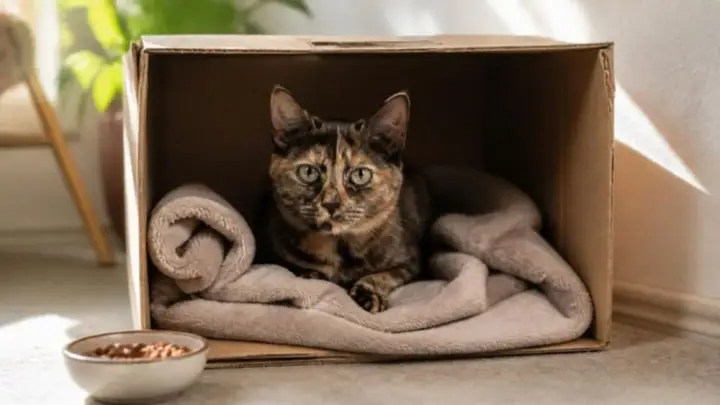
A cat turns up in a cardboard box behind a store, under a parked car, or on the balcony of an apartment its family has left. It is thin and frightened, and it has no collar.
Scenes like this are common, and what happens next follows a fairly predictable path. The medical side is usually the quicker part. The slower part is teaching a scared cat that people are safe again, which can take weeks or months.
One cat’s story
She was found in a cardboard box behind a supermarket, dehydrated and roughly nine months old, with no chip and no collar.
The medical work was straightforward: fluids, a course of antibiotics, treatment for ear mites, and a spay once she had recovered enough weight to be safely anesthetized.
The behavioral work took longer. She spent six weeks in a quiet foster placement before she would eat in front of a person, and another four before she started to seek contact.
She was adopted in the spring by a couple who had specifically asked for a cat that needed time. Eighteen months on, she sleeps on the back of the sofa in the middle of the room.
The first days: stray, abandoned or feral
The first question is what kind of cat this is, because it changes what you do. An abandoned pet cat has lived with people and usually wants to be near them, even if fear makes it hide at first. A feral cat was born and raised outdoors with little human contact and may never be comfortable being handled. The word stray is used for both, and many street cats fall somewhere in between.
The difference is not always clear on the first day. A terrified pet cat can hiss and hide just like a feral one. Over a few days the signs of a former pet usually show: the cat meows at people, looks at them, comes closer at feeding time or rubs against objects near them.
Kittens need extra thought before anyone steps in. A litter found alone may not be abandoned at all, because the mother often leaves to find food and comes back. Unless the kittens are in danger, soaked, or crying without pause for hours, it is usually best to watch from a distance for a while, since very young kittens do far better with their mother than with any human.
Frightened cats are rarely caught by chasing them, and a cat that has been chased once hides better the next time. Rescuers rely on food, patience and a humane trap, a cage whose door closes behind the cat once it steps inside to eat.
If you have found a cat in trouble, send us the exact location, and a photo if you can take one safely, through our contact page. Please do not try to catch it yourself, even if it looks hurt. We rescue kittens and cats as well as dogs, but we can help in person only in the Balkan region. Elsewhere we pass reports on to partner organizations and volunteers, so please also call your local animal control or an emergency vet.
The first vet visit
The first stop after any rescue is a vet. A newly found cat is usually checked for the following:
- A microchip, in case it is a lost pet with a family searching for it.
- Dehydration and weight loss.
- Fleas, ear mites and intestinal worms, which are very common in cats living outdoors.
- Signs of an upper respiratory infection: sneezing, runny eyes and a runny nose.
- Wounds, abscesses, and problems with the teeth or gums.
- In many clinics, a blood test for feline leukemia virus and feline immunodeficiency virus.
Most of these problems respond well to treatment, although a cat that tests positive for either virus needs a longer talk with the vet about its care and about living with other cats. Parasites are usually dealt with first, and the cat is vaccinated against the common serious diseases once the vet judges it healthy enough. At Paw Squadron, every animal we rescue, cats included, gets a checkup, the treatment it needs, vaccinations and a microchip.
Neutering comes once the cat is strong enough for surgery. For a cat that arrived underweight or ill, that can mean waiting until it has recovered. For a kitten, the vet looks at age and weight, and vets differ on the ideal age, so ask yours what they recommend and why.
A quiet room and some time apart
A newly rescued cat should be kept apart from other cats for as long as the vet recommends, often one to two weeks. Respiratory infections and other diseases spread easily between cats, and a new arrival may not show symptoms right away.
A small, quiet space works better than a whole house, because a frightened cat settles faster in a space it can learn quickly. Give it somewhere to hide, such as a covered bed or a cardboard box on its side, and keep food, water and the litter box well apart from each other. Hiding is normal, and nobody should pull a cat out of its hiding place.
The slow part: learning to trust
Some abandoned cats settle within days. Others need weeks before they will eat while a person is in the room, and weeks more before they come over on their own. Progress comes from repetition and from letting the cat set the pace:
- Visit at the same times each day, especially at mealtimes, so your arrival predicts food.
- Sit on the floor, turned slightly away, and talk or read quietly instead of reaching for the cat.
- Blink slowly when the cat looks at you. Cats often blink back, and it is a relaxed, friendly signal.
- Play with a wand toy, which lets the cat engage with you from a distance it feels safe at.
Watch for signs that things are moving: eating while you are nearby, grooming in front of you, sleeping out in the open, walking toward you with the tail held straight up, or kneading a blanket. Each one means the cat feels a little safer than it did the week before.
Finding the right home
Not every home suits every cat. A shy cat that took months to trust one person usually does best in a calm household with little coming and going. A confident young cat may enjoy a livelier home, and two kittens adopted together often keep each other company and spend their energy on each other instead of on the furniture.
A good rescue asks adopters about their routine and other pets, and tells them honestly what the cat is like, difficult parts included. Before taking in a rescued cat, ask how it reacts to strangers, to other animals and to being picked up. Our page on how a rescue works covers each stage, from the rescue itself to adoption.
The first weeks in a new home
Moving is stressful for any cat, so the new home should repeat the approach that worked in the rescue room. Start the cat in one quiet room with its bed, litter box, food and water, and keep the food and litter it is used to, at least at first. Open up the rest of the home one room at a time, once the cat is eating, using the litter box and exploring its first room with confidence. If the new arrival is a kitten, see our guide to caring for a new kitten.
If there are other pets, keep them apart at first and introduce them slowly, scent before sight. Our guide to raising a dog and a cat together walks through the steps. Keep the cat indoors for at least the first few weeks, since a cat that escapes before it knows its new home may not find its way back.
Register with a local vet, book a first checkup, and make sure the microchip is registered to your name and current phone number; our article on microchipping explains how. A cat that was friendly at the rescue often hides for a few days in a new home. That does not mean the match is wrong, and with the same patience it needed the first time, it usually comes out faster.
When to call a vet
Some problems cannot wait for the cat to settle in. Call a vet promptly if you notice any of these:
- The cat has not eaten for more than a day, or a kitten has skipped several meals. In cats, a few days without food can lead to serious liver disease.
- It strains in the litter box and passes little or no urine. In male cats especially, this can be an emergency.
- It breathes with its mouth open, or its breathing looks fast or labored while it is resting.
- It vomits repeatedly, has diarrhea for more than a day, or seems weak and unresponsive.
- Discharge from the eyes or nose gets worse instead of better.
If you are unsure whether something is serious, phone the clinic and describe what you see. The staff can tell you whether the cat needs to be seen today or can wait for a regular appointment.
Ayrıca bakınız
Kurtarmalarımızdan
 11:00Terk Edilen Yavru Köpek Çöp Konteynerine Atıldı, Bu Olana Kadar Hayatta Kalma Mücadelesi VerdiBruce Springclean · 18 Haziran 2022
 12:49Terk Edilen Yavru Köpek, Bu Olana Kadar Çaresizce Yardım İçin YalvarıyorduShania Drain · 9 Mart 2022
 9:33Terk Edilen Yavru Köpek, Bu Olana Kadar Gözyaşları İçinde Hayatta Kalma Mücadelesi VeriyorduDustin Timberlake · 5 Mart 2022
Bu makale genel bilgi amaçlıdır, veteriner tavsiyesi değildir. Hayvanınızın sağlığıyla ilgili her zaman bir veteriner hekime danışın. PawPedia’daki bazı görseller yapay zekâ ile oluşturulmuş olabilir.
Bu sayfa en son 30 Eylül 2026 tarihinde güncellendi.