Indoor vs Outdoor Cats: Risks, Benefits, and Safe Compromises
From PawPedia, an encyclopedia of life with animals
Fact-checked against expert sources
Contents
- (Top)
- The risks of going outside
- The risks of staying indoors
- The benefits of outdoor access
- Cats that are better off indoors
- Catios and outdoor enclosures
- Harness training
- Window perches and indoor enrichment
- If your cat goes out freely
- Cats and wildlife
- Rescue cats and former street cats
- See also
- From our rescues
- Sources
In short
There is no single right answer: each lifestyle has risks, and the best choice depends on your cat, home and surroundings. Outdoor cats face traffic, parasites, fights and poisons, while indoor cats risk boredom, stress and weight gain. A catio, cat-safe fencing or a well-enriched home can give many cats the best of both.
| Short answer | There is no single right answer; each lifestyle has risks, and the best choice depends on the cat, the home and the surroundings |
|---|---|
| Outdoor risks | Traffic, parasites, fights and infections such as FIV, attacks by dogs, poisoning, getting lost, and stress from neighboring cats |
| Indoor risks | Boredom, stress, behavior problems, stress-related illness, weight gain and household hazards such as toxic plants and open windows |
| Better indoors | Cats with FIV, deaf or blind cats, cats with poor mobility, apartment cats, white and hairless cats, and kittens not yet fully vaccinated |
| Middle ground | A catio, cat-safe fencing or walks on a harness give controlled outdoor access |
| Harness walks | PDSA and Cats Protection do not recommend lead walks for most cats; if you try, use a cat harness, never a collar, and keep outings to five to ten minutes |
| Indoor enrichment | A high window perch, cat trees, hiding places, tall scratching posts, daily play, puzzle feeders and one litter box per cat plus one extra |
| If your cat goes out | Keep it in from dusk to dawn, neuter and microchip it, and keep vaccinations and flea and worm treatments current |
| New cats | Keep a newly adopted cat indoors for at least the first two to three weeks |
| Kittens | Supervise them outdoors until about six months old |
| Wildlife | Keeping cats in at night, using enclosures and playing hunting games indoors all reduce the birds and small mammals they catch |
Few cat questions start more arguments than this one. Some people feel a cat belongs outside, others that a good home keeps a cat in. Vets and cat welfare groups mostly agree that there is no single right answer. Each lifestyle carries risks, and the best choice depends on your cat, your home and your surroundings. This guide sets out the trade-offs and the middle-ground options that give many cats the best of both.
The risks of going outside
Outdoor cats face dangers that indoor cats rarely meet.
- Traffic accidents. The risk rises after dark, when headlights can dazzle cats.
- Infectious disease and parasites. A global review of 21 studies found that cats with outdoor access were 2.77 times as likely to carry parasites as indoor-only cats. These included Toxoplasma, which can also infect people; see toxoplasmosis in cats.
- Fights with other cats, which cause bite wounds and abscesses and spread infections such as FIV.
- Attacks by dogs and other predators.
- Poisoning, for example from antifreeze, pest control chemicals, weed killers and lilies. Cats can be poisoned just by brushing against lily pollen and then grooming.
- Getting lost, shut in a shed or garage, or stolen.
- Long-term stress from sharing territory with neighboring cats.
Young cats and male cats take more risks outdoors, so they are more likely to be injured.
The risks of staying indoors
Indoor life removes most of those physical dangers, but it brings its own. International Cat Care points out that the biggest risks for indoor-only cats are to their emotional wellbeing. A home is predictable, and it offers fewer chances to hunt, climb, explore and make choices.
- Boredom, frustration and chronic stress
- Behavior problems such as urine spraying, scratching furniture, excessive meowing and anxiety
- Stress-related illness, such as feline idiopathic cystitis and over-grooming, especially in homes with several cats
- Weight gain from a less active life
- Household hazards, such as toxic plants, medicines, cleaning products, burns and falls from open windows
An indoor cat that escapes may also cope poorly outside, because it does not know the area or its dangers.
The benefits of outdoor access
Outside, cats can climb, stalk, run, scratch on trees and choose where to spend their time. That variety meets many natural needs and keeps them active. The American Association of Feline Practitioners (AAFP), in a 2024 position statement, says that a cat's environmental needs should guide its lifestyle, that each option has risks and benefits, and that safe, controlled outdoor access gives a cat a more stimulating environment.
Cats that are better off indoors
For some cats, the risks outside clearly outweigh the benefits.
- Cats with FIV, which can pass the virus to other cats through bites
- Deaf or blind cats, cats with poor mobility and older cats with confusion
- Cats in apartments with no safe way out
- White cats, which are prone to sun-related skin cancer, and hairless breeds such as the Sphynx, which suffer in cold and sun
- Kittens that are not yet fully vaccinated, neutered and microchipped
- Newly adopted adult cats, for at least the first two to three weeks
International Cat Care advises supervising kittens outdoors until they are about six months old.
Catios and outdoor enclosures
A catio is a secure outdoor enclosure. It can be attached to a window or door, or stand on its own in the yard with a covered run leading to it. It gives your cat fresh air, sunshine, smells and sounds without traffic or roaming. The AAFP lists outdoor enclosures, cat-safe fencing and harness walks as ways to offer controlled outdoor access.
- Add shelves and ramps at different heights.
- Provide shade, shelter from rain and a hiding spot.
- Include a scratching post or log.
- For longer stays, offer water and a litter box.
- Use only cat-safe plants, and check regularly for gaps and loose mesh.
Cat-safe fencing around a whole yard is another option, as long as it is checked often for places a cat could climb over or squeeze under.
Harness training
Some cats enjoy short outings on a harness, but many do not. The UK charities PDSA and Cats Protection do not recommend lead walks for most cats, because being restrained and unable to flee from a threat can be very stressful. If you want to try, go slowly.
- Use a harness made for cats. Never attach a lead to a collar, which can slip off or choke.
- Start indoors with short sessions and treats, ideally while your cat is young.
- Never force it. Go back a step if your cat seems uneasy.
- Begin in your own yard or another quiet place away from roads and dogs.
- Keep the lead slack and let your cat choose where to go.
- Keep early outings to about five to ten minutes, and head home at the first sign of stress.
- Make sure your cat is microchipped first, in case it slips out of the harness.
Window perches and indoor enrichment
For cats that live fully indoors, the home has to provide what the outdoors would. International Cat Care suggests the following.
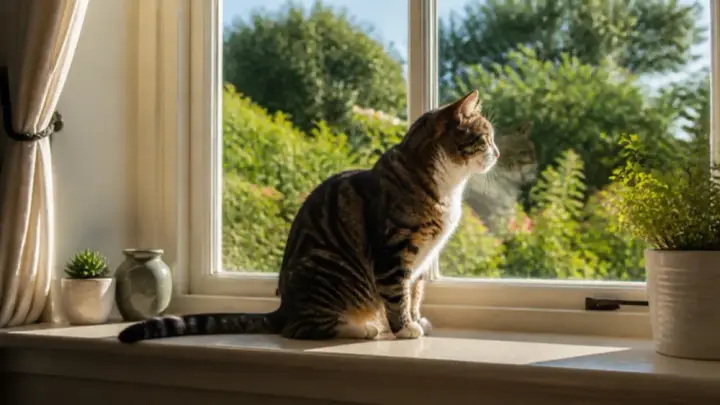
- A high perch by a window, so your cat can watch birds and passersby from a safe spot. Potted cat-safe plants by the glass can make the view feel more secure.
- Vertical space, such as cat trees and sturdy shelves
- Hiding places your cat can retreat to without being disturbed
- Tall scratching posts in a few different materials
- Daily play with toys that move like prey, rotated so they stay interesting
- Puzzle feeders and small meals spread through the day, so your cat works for its food
- One litter box per cat, plus one extra, in quiet places away from food and water
Keeping an indoor cat lean also takes effort. Our guide to overweight dogs and cats explains how to check body condition and adjust portions.
If your cat goes out freely
A few habits make outdoor access much safer.
- Keep your cat in at night, from dusk to dawn. This protects your cat and local wildlife. Provide a litter box, food, water and toys indoors.
- Neuter your cat. Neutering reduces roaming and fighting; see spaying and neutering cats.
- Microchip your cat and keep your details up to date. If your cat wears a collar, choose a quick-release type that fits with two fingers underneath.
- Keep vaccinations and flea and worm treatments current.
- Start with short, supervised trips. Teach your cat to come when called indoors first, using treats.
- Feed meals at times that keep your cat home during rush hour.
- Check sheds, garages and the space under parked cars before you close or drive off.
Even indoor cats need preventive care, since parasites and some infections can still reach them. Ask your vet what suits your cat's lifestyle.
Cats and wildlife
Cats are skilled hunters, even when they are well fed. Keeping cats in at night, using enclosures and playing hunting games with them indoors all reduce the number of birds and small mammals they catch.
Rescue cats and former street cats
Many rescued cats have spent part of their lives outdoors. The AAFP notes that some cats cannot have their needs met indoors, including cats used to living outside, and that forcing them into confinement can harm their welfare. Many others adapt well to indoor life when the home gives them space, play and places to hide. Give any new cat time to settle before deciding, and keep a newly adopted cat indoors for at least the first few weeks either way.
At Paw Squadron, every rescued cat sees a vet and is dewormed soon after rescue. If you adopted a cat from us and are unsure whether it should go outside, write to us from the Contact page and tell us about your home.
For more guides on cat care, browse PawPedia.
See also
From our rescues



Sources
Online sources
- Should I keep my cat indoors or allow outdoor access? · International Cat Care
- Making your home cat friendly · International Cat Care
- 2024 Indoor/Outdoor Lifestyle Position Statement · American Association of Feline Practitioners (FelineVMA)
- Who let the cats out? A global meta-analysis on risk of parasitic infection in indoor versus outdoor domestic cats (Felis catus) · Biology Letters (Chalkowski et al., 2019)
- Walking a cat on a lead: is it a good idea? · PDSA
- Should I walk my cat on a harness and lead? · Cats Protection
- Keeping cats safe outside · Cats Protection
Encyclopedias
- Cat · Wikipedia
- Cat predation on wildlife · Wikipedia
- Cat · Encyclopædia Britannica
- О. А. Сизова. Кошка домашняя [Cat] · Большая российская энциклопедия, электронная версия (archived copy)
- ネコ [Cat] · 日本大百科全書(ニッポニカ), 小学館, via Kotobank
Books
- Turner DC, Bateson P (eds.). The Domestic Cat: The Biology of its Behaviour. 3rd ed. Cambridge: Cambridge University Press, 2014. ISBN 9781107025028
- Bradshaw JWS, Casey RA, Brown SL. The Behaviour of the Domestic Cat. 2nd ed. Wallingford: CABI, 2012. ISBN 9781845939922
- Rodan I, Heath S (eds.). Feline Behavioral Health and Welfare. St. Louis: Elsevier, 2015. ISBN 9781455774012
- Блохина Т. В. Фелинология: учебное пособие [Felinology: A Study Guide]. 2-е изд. Санкт-Петербург: Лань, 2014. ISBN 9785811415175
- 大石孝雄. ネコの動物学 [The Zoology of the Cat]. 東京: 東京大学出版会, 2013. ISBN 9784130622240
This article is general information, not veterinary advice. Always consult a veterinarian about your animal’s health. Some pictures in PawPedia may be AI-generated.
This page was last updated on October 31, 2026.