Cat in Heat: Signs, How Long It Lasts, and What to Do
From PawPedia, an encyclopedia of life with animals
Fact-checked against veterinary sources
Contents
In short
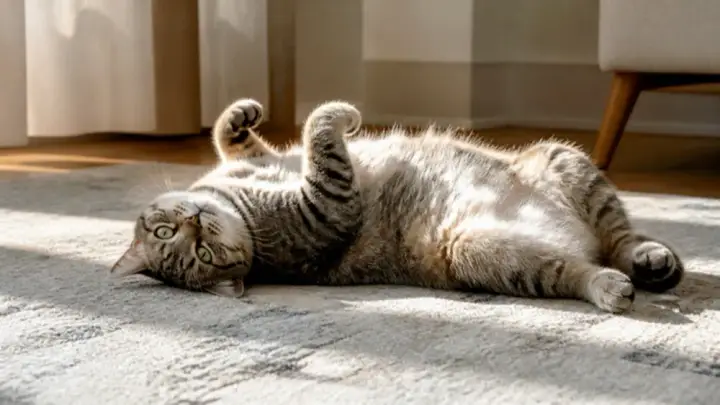
A cat in heat yowls loudly, rolls on the floor, rubs against people and objects and raises her rear with her tail held to one side. Each heat lasts about a week on average and, if she does not mate, usually returns every two to three weeks through the breeding season. Spaying stops the cycles for good.
| Cause | A normal, hormone-driven cycle in female cats that have not been spayed; longer daylight hours switch it on |
|---|---|
| Usual age | First heat at about six months, sometimes as early as four months; shorthaired cats tend to start earlier than longhaired cats |
| Common signs | Loud, repeated yowling, unusual affection, rubbing, rolling, raising the hindquarters, treading with the back feet, restlessness, trying to get outside, and peeing or spraying more; cats very rarely bleed |
| How long it lasts | The receptive phase lasts about seven days on average (one day to three weeks); without mating she goes out of heat for about a week, then returns, so the cycle repeats about every three weeks |
| Pregnancy | Mating triggers ovulation and ends the heat; an unspayed cat can have up to three litters a year |
| Home care | Keep her indoors and away from unneutered males, play with her more, offer a warm quiet bed and a very clean litter box, and do not scold her for calling |
| Treatment | Spaying is the only lasting way to stop heat; it can be done during a heat, with only a slight rise in bleeding risk |
| Prevention | Spay before the first heat; International Cat Care recommends neutering at around four months, and a cat does not need a heat or a litter first |
| Never give | Hormone tablets or injections to stop heat unless a vet recommends them; they can cause uterus infection, diabetes and mammary cancer |
| Emergency if | An unspayed cat seems ill: tired, poor appetite, vomiting, drinking and peeing more, a swollen belly or any discharge from the vulva, which can mean pyometra |
If your young female cat suddenly starts yowling, rolling on the floor and pressing herself against your legs, she is probably in heat. Many owners worry that their cat is in pain or unwell. In most cases, heat is a normal part of life for a female cat that has not been spayed. This guide explains the signs, how long heat lasts and how often it comes back, how to help her through it, and why early spaying is the lasting answer.
When cats first come into heat
Most female cats reach puberty at about six months of age, but some come into heat as early as four months. Shorthaired cats tend to start earlier than longhaired cats. Cats are long-day breeders, which means longer daylight hours switch the cycles on. In the Northern Hemisphere, the breeding season runs roughly from late winter into fall. Cats that live indoors under artificial light, or in warm climates, may cycle all year round.
Signs of a cat in heat
Heat in cats shows mostly in behavior. Unlike dogs, cats very rarely bleed when they are in heat. Common signs include the following.
- Loud, repeated yowling or calling, which can sound as if she is in pain
- Being unusually affectionate and demanding attention
- Rubbing her head and body against people, furniture and doorways
- Rolling on the floor
- Raising her hindquarters when stroked along the back, with the tail moved to one side
- Treading or kneading with her back feet
- Restlessness and repeated attempts to get outside
- Peeing more often, or spraying urine on walls and doors
Some cats seem unsettled or a little under the weather, especially during their first heat. The heat itself is not thought to be painful. The spraying and calling send a message to male cats, and you may notice unneutered toms hanging around outside.
How long it lasts and how often it returns
The part of the cycle when a cat will accept a male lasts about seven days on average. It can be as short as one day or as long as three weeks. If she does not mate, she goes out of heat for about a week, then comes back in. On average, the full cycle repeats about every three weeks, so many cats are in heat every two to three weeks through the breeding season.
Cats are induced ovulators. Mating triggers the release of eggs, and heat ends within a day or two once she ovulates. This is why a cat that does not mate can keep cycling again and again. Pregnancy stops the cycles, and so can a false pregnancy for a time.
A heat that seems to go on for more than three weeks is worth a vet visit. Cysts on the ovaries can cause long-lasting heat, although this can be hard to tell apart from frequent normal cycles.
Pregnancy can happen fast
A cat in heat will try hard to get outside, and if she does, an unneutered male is very likely to find her. Kittens can reach sexual maturity from about four months of age, and an unspayed cat can have up to three litters a year. If you think your cat may have mated, talk to your vet soon about the options.
Why early spaying helps
Spaying is the only lasting way to stop heat. It also prevents pregnancy and protects against serious disease later in life.
- No more heat cycles, with the yowling, spraying and escape attempts that come with them
- No risk of pyometra, a life-threatening infection of the uterus
- No risk of ovarian or uterine cancer
- A much lower risk of mammary cancer. Cornell University's Feline Health Center notes that spaying a kitten at three to six months, before her first heat, virtually eliminates that risk.
- No unplanned litters
Your cat does not need to have a heat or a litter before she is spayed. International Cat Care recommends neutering at around four months of age, before most cats reach sexual maturity. The traditional age of six months comes after many cats have already had their first heat. Kittens usually go home the same day and are back to normal by the next day. Ask your vet what timing suits your cat, and see our guide to Spaying and Neutering Cats for recovery tips.
Can a cat be spayed while she is in heat? Yes. VCA notes that the extra blood flow to the reproductive tract raises the risk of bleeding during surgery, but generally only slightly in cats. Your vet will advise whether to go ahead or wait a few days.
How to calm a cat in heat
There is no safe way to switch off a heat at home, but you can make the days easier for both of you.
- Keep her indoors, with windows and doors shut, for the whole heat.
- Keep her away from unneutered male cats, including any in your own household.
- Play with her more. Wand toys, food puzzles and treat-filled toys give her something else to focus on.
- Give her attention and gentle stroking if she enjoys it, and let her rest when she wants to.
- Offer a warm, cozy bed in a quiet spot.
- Keep her litter box very clean, and clean any urine marks thoroughly.
- Do not scold her for calling. It is driven by hormones, and punishment only adds stress.
Avoid hormone tablets or injections meant to stop heat unless your vet recommends them for a specific reason. The Merck Veterinary Manual notes that medicines used to suppress heat can cause infection of the uterus, diabetes and mammary cancer, and Cornell warns that such hormones can triple the risk of mammary cancer in unspayed cats. If your cat sprays during heat, our guide to cats peeing outside the litter box explains how to clean up and when spraying has other causes.
When to see a vet
Heat is normal, but some signs suggest something else is going on. Contact your vet if your cat shows any of the following.
- Blood, pus or any other discharge from the vulva
- Low energy, a poor appetite, vomiting, or drinking and peeing much more than usual
- A swollen belly when she is not known to be pregnant
- Heat that seems to last more than three weeks
- Heat behavior after she has been spayed
- Rapidly swelling, firm mammary glands
- Crying that sounds different from her usual heat calls, or signs of pain when touched
Pyometra is the most urgent of these. It is a bacterial infection of the uterus in unspayed cats, and it can develop after a heat. Signs include tiredness, poor appetite, increased thirst and urination, and vomiting. A discharge may or may not be present, since the cervix can stay closed and the uterus can fill without anything showing. Signs can progress quickly to shock and death, so an unspayed cat that seems ill needs a vet the same day.
Heat signs after spaying usually point to ovarian remnant syndrome, where a small piece of ovary was left behind and keeps producing hormones. Fast swelling of the mammary glands in a young cycling or pregnant cat may be mammary hypertrophy, a hormone-driven, noncancerous condition that is usually treated by spaying. Any lump in the mammary glands needs checking soon, because Cornell reports that about 85 percent of mammary tumors in cats are malignant. See Mammary Tumors in Cats.
How cats differ from dogs
Heat in cats looks very different from heat in dogs. Female dogs usually show a bloody discharge and come into heat far less often, while cats cycle again and again through the season and rarely bleed. For the dog version, see The Heat Cycle in Female Dogs. Male cats need neutering too. Unneutered males roam, fight and spray to mark territory, and neutering at three to six months reduces these behaviors.
Adopting a young cat
Every unplanned litter means more kittens who need homes. At Paw Squadron, we rescue cats as well as dogs, and every cat we take in sees a vet first for a checkup, deworming and parasite treatment. If you adopt a young female, talk to your vet early about spaying, ideally before her first heat. Our guide on how to adopt a rescue cat covers the first weeks at home.
For more guides on cat health, browse PawPedia. Questions about adopting a cat from us are answered in our FAQ.
See also
From our rescues


Sources
Online sources
- Estrous Cycles in Cats · VCA Animal Hospitals
- Spaying in Cats · VCA Animal Hospitals
- Management of Reproduction of Cats · Merck Veterinary Manual
- Reproductive Disorders of Female Cats · Merck Veterinary Manual
- Cats in heat (coming into season) · PDSA
- Neutering your cat · International Cat Care
- Spaying and Neutering · Cornell Feline Health Center
- Mammary Tumors · Cornell Feline Health Center
Encyclopedias
- Estrous cycle · Wikipedia
- Estrous cycle · Encyclopædia Britannica
Books
- Johnston SD, Root Kustritz MV, Olson PNS. Canine and Feline Theriogenology. Philadelphia: Saunders, 2001. ISBN 9780721656076
- Ettinger SJ, Feldman EC, Côté E (eds.). Textbook of Veterinary Internal Medicine: Diseases of the Dog and the Cat. 8th ed. St. Louis: Elsevier, 2016. ISBN 9780323312110
- Little SE (ed.). The Cat: Clinical Medicine and Management. St. Louis: Elsevier Saunders, 2012. ISBN 9781437706604
- Щербаков Г. Г. и др.; под общ. ред. Г. Г. Щербакова. Внутренние болезни животных: учебник [Internal Diseases of Animals: A Textbook]. Санкт-Петербург: Лань, 2014. ISBN 9785811416820
- 田中茂男、津曲茂久、鎌田寛、亘敏広. 猫の医学 [Feline Medicine]. 東京: 時事通信出版局, 2011. ISBN 9784788711617
This article is general information, not veterinary advice. Always consult a veterinarian about your animal’s health. Some pictures in PawPedia may be AI-generated.
This page was last updated on November 12, 2026.