Budgie (Parakeet) Care Basics: Cage, Diet, and Taming
From PawPedia, an encyclopedia of life with animals
Fact-checked against expert sources
Contents
In short
Budgies need a large cage, daily flight in a safe room, a budgie companion, and a diet built on pellets with vegetables and leafy greens rather than seed alone. Keep overheated non-stick cookware away, because its fumes can kill a bird quickly. See a bird vet promptly for fluffed feathers, tail bobbing or open-mouth breathing.
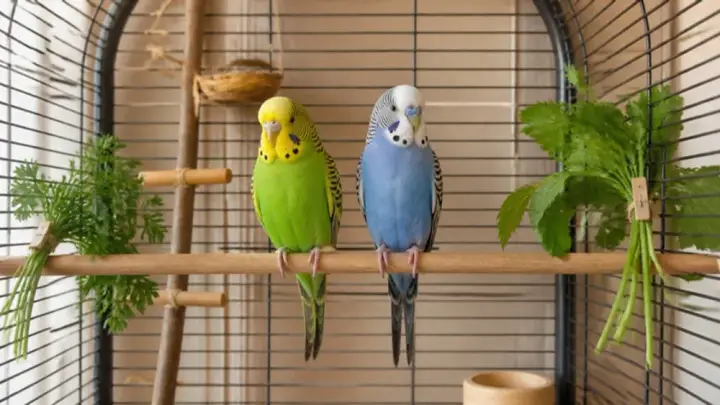
| Lifespan | 10 to 15 years in good care |
|---|---|
| Company | Pair each budgie with at least one other budgie for life; a single bird needs time with you every day |
| Cage | The largest you can; the Merck Veterinary Manual gives a minimum of about 51 by 51 by 76 cm with bars no more than 1.3 cm apart, zinc-free and non-toxic |
| Flight | Out of the cage every day in a room with windows and doors closed, fans off, no cats or dogs, and you present |
| Light | Needs ultraviolet light, so fit a bird lamp above the cage because window glass filters most of it out |
| Diet | Pellets make up about 60 to 80 percent, the rest mainly vegetables and leafy greens; seeds only as treats, and no grit |
| Never feed | Avocado, chocolate, caffeine, alcohol, salty snacks or food cooked in butter or oil |
| Fumes | Overheated non-stick (PTFE) cookware can kill a bird quickly, even from another room; smoke, plug-in air fresheners and aerosols also harm |
| Taming | Give a few days to settle, then offer treats through the bars and later from an open hand; never grab or chase |
| Vet checks | A health check soon after you bring it home, then at least once a year; VCA suggests twice a year |
| See a vet if | Fluffed feathers, tail bobbing, open-mouth breathing, discharge, changed droppings, weakness, bleeding or a fall; contact with a cat or dog and exposure to fumes are emergencies |
Budgies, called parakeets in the US, are small parrots from the dry inland regions of Australia. They are among the most popular pet birds in the world: cheerful, chatty, curious and gentle. They are also easy to underestimate. A budgie can live 10 to 15 years in good care, and it needs space to fly, company, a varied diet and daily attention. This guide covers the basics.
Budgies are flock birds
In the wild, budgies live in large flocks that roam over the plains. They are social birds, and the Royal Veterinary College in London recommends pairing each budgie with at least one other budgie for life. A companion budgie gives the kind of company that even a devoted owner cannot provide all day.
A single budgie can bond closely with people, but it then depends on you for almost all of its social contact. If you keep one bird, plan to spend time with it every day. Have any new bird checked by a vet with bird experience before you introduce it to your other birds, and introduce them gradually.
In adult budgies, you can usually tell males from females by the cere, the band of bare skin above the beak around the nostrils. It is usually blue in adult males and pink-brown in adult females, though young birds and some color varieties are harder to read.
Cage and setup
Budgies are built for flight, so buy the largest cage you have room for and can afford. The Merck Veterinary Manual gives a minimum of 20 by 20 by 30 inches (about 51 by 51 by 76 cm) for birds of this size, with bars no more than half an inch (about 1.3 cm) apart. At the very least, the cage must let your budgie stretch its wings fully in every direction.
- Choose a cage and toys labeled zinc-free and made of non-toxic materials. Zinc poisoning is increasingly seen in pet birds, and old paint, keys and lead weights are other sources of heavy metals.
- Replace smooth plastic or dowel perches with natural branches of different thicknesses. Washed and disinfected fruit tree branches are a good choice, and they help prevent foot injuries and overgrown nails.
- Avoid sandpaper perch covers, which rub the feet without keeping the nails short.
- Place the cage out of direct sun and drafts, and away from the kitchen.
- Offer a few sturdy, bird-safe toys and swap them regularly, since flimsy toys are quickly destroyed.
- Provide a shallow dish of water for bathing as well as drinking water, and change both daily.
- Clean the cage at least once a week with a bird-safe disinfectant, and wash food and water dishes every day.
Budgies also need ultraviolet light, both for normal behavior and to use calcium properly. Window glass filters out much of it, so the Royal Veterinary College recommends a bird lamp fitted above the cage and shining downward.
Daily flight in a safe room
Free flight is essential, and budgies should have the chance to fly outside the cage every day. Before you open the cage door, make the room safe.
- Close all windows and doors, and block off any chimney
- Turn off fans and heaters
- Remove poisonous houseplants
- Keep dogs and cats out of the room, however friendly they seem
- Stay in the room while your budgie is out
Dogs and cats are natural predators of small birds, and a budgie should never be left alone with them. If you have both, our guide to raising a dog and a cat together covers how to manage several pets in one home.
Fumes and household dangers
A bird's lungs are very efficient at taking in air, which also makes birds very sensitive to fumes. The best-known danger is PTFE, the non-stick coating used on many pans. When non-stick cookware is overheated, it releases fumes that can kill a bird quickly, even in another room. Other sources include some clothing irons, ironing board covers, heat lamps and heating elements. Sudden death may be the only sign.
VCA Animal Hospitals advises that the only fully reliable prevention is to keep PTFE products out of a home with birds. If you do use them, never overheat them or leave them unattended, open the windows, run the exhaust fan and keep your budgie out of the kitchen.
Tobacco smoke, plug-in air fresheners, aerosol deodorants and similar products can also irritate a bird's airways and, in some cases, be fatal. If your budgie has been exposed to fumes, move it into fresh air at once and call your vet.
What to feed: seeds, pellets and greens
Seed mixes have long been the standard budgie food, but seed alone is not a complete diet. Seeds are high in fat and carbohydrates and low in protein and many vitamins and minerals. Budgies also tend to pick out their favorites, such as millet, and leave the rest. According to VCA, a seed-only diet can lead to ill health and may shorten a budgie's life.
Most avian vets now recommend a good-quality pelleted food made for small birds as the base of the diet. Advice on the exact share varies, but pellets usually make up about 60 to 80 percent, with the rest mainly vegetables and leafy greens.
Good vegetables include broccoli, kale, spinach, carrot, sweet potato, bell pepper and squash. Wash them well, cut them into small pieces, serve them in a separate dish and remove leftovers after a couple of hours. Pale, watery vegetables such as iceberg lettuce and celery add little nutrition. Small amounts of fruit, such as apple or banana, can be offered too.
Seeds still have a place as treats and training rewards. A millet spray is a favorite, but VCA suggests offering it only once or twice a month.
Switch a seed-eating budgie to pellets slowly. Small birds may not recognize pellets as food at first, and the change can take weeks or months. Mix pellets with the usual seed and shift the balance gradually, or scatter pellets on a flat tray to encourage foraging, since wild budgies feed on the ground. Watch closely to make sure your bird is really eating, and ask your avian vet for help if it is not.
- Budgies do not need grit. They remove seed hulls before eating, and too much grit can block the gut.
- Never feed avocado, which is toxic to birds.
- Avoid chocolate, caffeine, alcohol, salty snacks and food cooked in butter or oil.
- Keep fresh, clean water available at all times.
- Use vitamin supplements only on the advice of a vet with bird experience.
Several of these foods are dangerous for dogs and cats too, as our guide to common household poisons explains.
Taming and handling
Young budgies are usually easier to tame than older birds, and hand-raised babies often make confident pets. Patience matters more than age, though. Let your budgie set the pace, and keep each session short.
- Give a new budgie a few days to settle in before you try to handle it.
- Sit near the cage and talk softly, so your voice becomes familiar.
- Offer a small treat through the bars, and later from your open hand.
- Once your budgie takes food calmly from your hand, slowly offer a finger as a perch just in front of its feet.
- Stop before your bird becomes stressed, and never grab or chase it around the cage.
Many budgies come to enjoy gentle head scratches once they trust you. They are also good mimics. Some learn hundreds of words, especially when training starts young, and males often talk more readily than females. The same slow, reward-based approach that helps any nervous animal is described in bonding with a rescue animal.
Signs of illness
Birds instinctively hide weakness, because in the wild a sick bird is an easy target. By the time a budgie looks ill, it may have been sick for days or even weeks. Small changes matter. See a vet with bird experience promptly if you notice any of the following signs.
- Fluffed-up feathers, sleeping more, or sitting low on the perch or on the cage floor
- Tail bobbing with each breath, open-mouth breathing, wheezing or sneezing
- Discharge or crusts around the nostrils or eyes
- Changes in droppings, such as watery, mushy, black, red or pale droppings, or fewer droppings than usual
- Eating or drinking more or less than usual, or weight loss
- Vomiting or bringing up food, which can leave the head feathers matted
- Weakness, a head tilt, loss of balance or falling off the perch
- Crusty, flaky skin, or an overgrown or misshapen beak or nails
- Bleeding, a wound or any lump
Breathing problems, bleeding, a fall, contact with a cat or dog, and exposure to fumes are emergencies. Keep a sick bird warm and quiet in a small cage or carrier on the way to the vet.
Book a health check soon after you bring a budgie home, and then regularly after that. VCA recommends checkups twice a year, and the Royal Veterinary College suggests at least once a year. Not every vet treats birds, so find one with bird experience before you need one.
Adopting a budgie
Budgies can be found through reputable breeders and through bird rescue centers, which can often tell you about a bird's personality and history. Paw Squadron rescues dogs and cats rather than birds, but the same principles apply to every animal we place: a vet check and deworming after rescue, and a home that is ready for the animal's real needs. A budgie is a commitment of a decade or more, and it deserves the same thought as adopting a dog or cat. If you are comparing small pets, our guide to rabbit care basics covers another popular choice.
For more guides on caring for animals of all kinds, browse PawPedia. Questions about adopting from us are answered in our FAQ.
See also
From our rescues


Sources
Online sources
- Budgerigar Care (factsheet, reviewed November 2023) · RVC Exotics Service, Royal Veterinary College
- Budgies - Feeding · VCA Animal Hospitals
- Budgies - General · VCA Animal Hospitals
- Overview of Pet Birds · Merck Veterinary Manual
- Signs of Illness in Pet Birds · Merck Veterinary Manual
- Recognizing the Signs of Illness in Pet Birds · VCA Animal Hospitals
- Teflon (Polytetrafluoroethylene) Poisoning in Birds · VCA Animal Hospitals
- Don't Fly Blind When It Comes To Bird Nutrition · Texas A&M School of Veterinary Medicine and Biomedical Sciences
Encyclopedias
- Budgerigar · Wikipedia
- Budgerigar · Encyclopædia Britannica
- В. В. Иваницкий. Волнистый попугай [Budgerigar] · Большая российская энциклопедия, т. 5, Москва, 2006, с. 640 (archived copy)
- セキセイインコ [Budgerigar] · 日本大百科全書(ニッポニカ), 小学館, via Kotobank
- Wellensittich [Budgerigar] · Brockhaus Enzyklopädie
Books
- Harrison GJ, Lightfoot TL (eds.). Clinical Avian Medicine. Palm Beach, FL: Spix Publishing, 2005. ISBN 9780975499405
- Дорош М. В. Лечение певчих и декоративных птиц [Treating Songbirds and Pet Birds]. Москва: Вече, 2009. ISBN 9785953334204
- Samour J (ed.). Avian Medicine. 3rd ed. St. Louis: Elsevier, 2016. ISBN 9780723438328
This article is general information, not veterinary advice. Always consult a veterinarian about your animal’s health. Some pictures in PawPedia may be AI-generated.
This page was last updated on November 5, 2026.