Mammary Tumors in Cats: Signs, Treatment, and Prevention
From PawPedia, an encyclopedia of life with animals
Contents
In short
Mammary tumors are lumps in the breast tissue along a cat's belly, and 80 to 90 percent of them are cancer. Spaying before 6 months of age lowers the risk the most. Have any lump checked within a few days, since small tumors have a much better outlook, and seek same-day care for open-mouth breathing or collapse.
| Affects | The breast tissue along a cat's belly; in cats, most of these lumps are cancer |
|---|---|
| Most at risk | Cats that were never spayed or were spayed later in life |
| Usual age | Most are diagnosed at around 10 to 12 years, although younger cats can be affected |
| First signs | Usually a small, firm nodule under or near a nipple |
| Common signs | A lump that grows over weeks or months or feels fixed in place; red, broken or bleeding skin over a lump; usually no pain early on |
| Diagnosis | A biopsy confirms the exact type and grade; often the whole lump is removed and sent to a lab |
| Treatment | Surgery is the main treatment, commonly removing the whole row of glands on the affected side |
| Outlook | Tumors removed while under 2 cm: cats often live three years or more; over 3 cm, survival is often measured in months |
| Prevention | Spaying, with the strongest protection from spaying before 6 months of age |
| Risk to people | Not contagious; it does not pass to other cats, dogs or people in the home |
| Emergency if | Open-mouth, fast or labored breathing at rest; collapse; a lump that bleeds heavily or is a large open wound; no food for a day or more |
Mammary tumors are lumps that grow in the breast tissue along a cat's belly. In cats, most of these lumps are cancer. Between 80 and 90 percent are malignant, compared with about half in dogs. Two things work in the owner's favor. The main risk factor is well understood, and tumors found while small have a much better outlook than large ones. This guide covers what to look for, how vets diagnose and treat the problem, and how spaying lowers the risk.
What mammary tumors are
Cats have four pairs of mammary glands, set in two rows that run from the armpits to the groin. A mammary tumor starts in this tissue, usually as a small, firm nodule under or near a nipple. It is the third most common type of tumor in cats. Most of the malignant ones are adenocarcinomas, a cancer that can spread through the lymph system and the blood.
When it spreads, it most often reaches the nearby lymph nodes and the lungs. It can also reach the lining of the chest, the liver, the kidneys and other organs. Cats often have more than one tumor at a time, so the vet will feel along both rows of glands, including the ones that look normal.
Mammary cancer is not contagious. It does not pass from one cat to other cats, to dogs, or to people in the home.
Which cats are at risk
Female hormones drive most of the risk. Cats that were never spayed, or were spayed later in life, have far higher rates of mammary cancer than cats spayed young. Studies summarized in veterinary references found clear differences by age at spaying.
- Cats spayed before 6 months of age had about a 91 percent lower risk than unspayed cats.
- Cats spayed before 12 months of age had about an 86 percent lower risk.
- Spaying after about 2 years of age appears to give little or no protection against these tumors.
Other factors play a part too. Most cats are diagnosed at around 10 to 12 years of age, although younger cats can be affected. Siamese cats have about twice the risk of other breeds and tend to develop tumors earlier. Hormone drugs given to stop heat cycles also raise the risk, and they can lead to mammary tumors in male cats as well as females. Apart from that, male cats develop mammary tumors only rarely.
Signs to watch for
In the early stage, a mammary tumor usually causes no pain and no change in behavior. The cat eats, plays and grooms as usual. For this reason many tumors are found late, when they are already large. Most of the early changes are easier to feel than to see.
- One or more small, firm lumps under the skin near a nipple
- A lump that grows over weeks or months
- A lump that feels fixed in place instead of moving freely under the skin
- Red, broken or bleeding skin over a lump
- An area of the belly that feels warm or seems sore when touched
When the cancer has spread, more general signs may appear. These include tiredness, weight loss, a poor appetite, coughing or trouble breathing. Yet almost half of cats whose cancer has reached distant organs show no outward signs of illness. A lump on its own is enough reason to see the vet.
When it is an emergency
A small new lump in a cat that seems well can wait for a regular appointment, ideally within a few days. Waiting to see whether it grows gives the tumor time to get bigger, and size is one of the strongest signs of how a cat is likely to do.
Same-day care is recommended if your cat breathes with her mouth open, breathes fast or with effort while resting, or collapses. The same applies to a lump that bleeds heavily or has turned into a large open wound, and to a cat with a known lump who stops eating for a day or more or becomes weak and withdrawn. Cancer that has spread to the chest can make breathing hard, and vets treat breathing trouble in a cat as an emergency.
How vets diagnose it
The vet will start with a full physical exam and will feel both rows of mammary glands and the nearby lymph nodes. The next step is often a fine needle aspirate. The vet collects a few cells from the lump with a thin needle and looks at them under a microscope. This can show whether the lump is a tumor. A biopsy is needed to confirm the exact type and grade, and often the whole lump is removed and sent to a lab.
Because this cancer can spread, the vet will usually suggest staging, which means finding out how far it has gone before planning treatment. Staging may include blood and urine tests, chest X-rays to look at the lungs, an abdominal ultrasound, and a sample from nearby lymph nodes. The size of the tumor is part of staging too. Tumors smaller than 2 cm, about three-quarters of an inch, belong to the earliest stage.
Not every swelling of the mammary glands is cancer. Cats that are not spayed can develop a benign swelling called mammary hyperplasia, which usually goes away after spaying. Only a vet can tell these conditions apart, so any swelling is worth a check.
Treatment and outlook
Surgery is the main treatment. Because cats often have several tumors, vets commonly recommend removing the whole row of glands on the affected side. This is called a full-chain mastectomy. Removing both rows has been linked with a lower chance of the cancer coming back, and it is often done as two operations a few weeks apart. Your vet will explain which approach suits your cat's age and general health.
Chemotherapy is sometimes offered after surgery or when the cancer has already spread. The evidence for its benefit in this disease is mixed, so it helps to ask the vet what it could realistically achieve for your cat. Pain relief and comfort care are part of treatment at every stage. When a cure is not possible, the aim is to keep the cat comfortable and eating well for as long as possible.
Size at diagnosis matters a great deal. Cats whose tumors are removed while smaller than 2 cm often live three years or more. With tumors of 2 to 3 cm, typical survival is around two years, and with tumors larger than 3 cm it is often measured in months. The tumor's grade and whether it has spread also shape the outlook, and your vet can explain what the results mean for your own cat.
Prevention and home checks
Spaying is the most effective way to lower the risk. The strongest protection comes from spaying before 6 months of age, so ask your vet about the best timing for your kitten. For a cat you do not plan to breed, vets generally prefer spaying over hormone drugs that stop heat cycles, since these drugs raise the risk of mammary tumors. Your vet can go over the options with you.
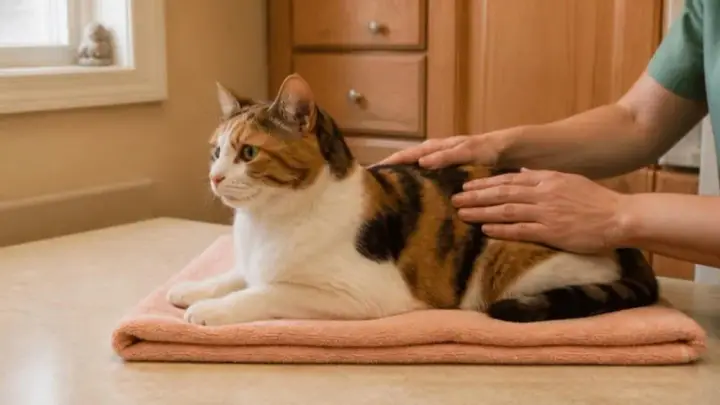
A regular check at home, for example once a week, helps you find lumps while they are small. With your cat relaxed on your lap or lying on her side, run your fingertips gently along both rows of nipples, from the armpits to the groin. Feel for firm nodules, which can be very small at first. Fit the check into a normal petting session and note anything new so you can show the vet. Your vet will also examine the glands at regular checkups, which matter more as cats get older.
Rescued and newly adopted cats
Adult female cats that come from the street often have an unknown past. Before rescue they may have gone through many heat cycles, or been given hormone injections to stop heat. Both can raise the risk of mammary tumors later in life. Spaying as an adult does little to lower this particular risk, so regular checks are worth keeping up.
At Paw Squadron, the first stops after every rescue are the vet and a bath, and every animal gets a checkup, treatment, vaccinations and a microchip before adoption. At your first visit with your own vet, bring her records and ask for a check of her mammary glands as part of the exam. Start the belly check early, so you learn what normal feels like for her. For more on adopting from us, see our FAQ or browse other guides in PawPedia.
See also
From our rescues


This article is general information, not veterinary advice. Always consult a veterinarian about your animal’s health. Some pictures in PawPedia may be AI-generated.
This page was last updated on October 6, 2026.