Bonding with a Rescue Animal
From PawPedia, an encyclopedia of life with animals
Contents
| Rule of thumb | The 3-3-3 rule: about three days to decompress, three weeks for routine, three months to feel at home |
|---|---|
| Takes | Some animals relax within days and others need half a year |
| First days | Keep the house quiet, put off visitors and keep the same daily order for meals, walks and bedtime |
| Safe spot | For a dog a bed in a quiet corner, for a cat a single room with places to hide; nobody reaches in or pulls it out |
| What helps | Hand-feeding, a simple and reliable way to build trust |
| Touch | Stroke for about three seconds, then stop and see whether the animal wants more |
| Stress signals | Lip licking, yawning when not tired, whites of the eyes showing, a tucked tail, turning the head away |
| Voice | A calm, warm voice used often, with each daily event given its own word, said the same way each time |
| Around week three | Many adopters notice the animal testing limits, which is usually a sign of progress |
| Avoid | Punishment of any kind, from shouting to a jerk on the leash |
| See a vet if | No food for a full day (puppies and kittens sooner), repeated vomiting, lasting or bloody diarrhea, weakness, sudden behavior change |
Most people who adopt picture the moment their new dog or cat runs to greet them at the door. That moment usually comes, but rarely in the first week. A rescue animal arrives with a history you cannot read, and the early weeks are spent showing it that this home is not another temporary stop.
Why trust takes time
Many rescued animals have learned that people and places are unpredictable. Some were abandoned, some survived on the street, and many have moved several times in a short period: from the spot where they were found, to a vet clinic, to the rescue, and now to your home. Every move brings new smells, new sounds and new rules.
Many rescuers sum up the first months with the 3-3-3 rule: roughly three days for the animal to decompress, three weeks to pick up the household routine, and about three months until it truly feels at home. Use it as a loose guide rather than a timetable. Some animals relax within days and others need half a year, but the pattern is common enough to be worth knowing.
The first days: less is more
In the first days, your job is to be calm and predictable. Keep the house quiet, put off visitors, and follow the same order every day for meals, walks and bedtime. An animal that can guess what comes next does not have to stay on guard, and that is what lets it rest.
Give the animal a spot that belongs to it alone. For a dog that might be a bed in a quiet corner, and for a cat a single room with a few places to hide. Nobody reaches in or pulls the animal out of that spot, and the more reliably that holds, the sooner it will come out on its own.
Expect some odd behavior. Many rescued animals eat little at first, sleep for long stretches, or seem flat and withdrawn, and that is usually stress rather than personality. Call your vet rather than waiting if a cat or an adult dog eats nothing for a full day, or if either one keeps vomiting, has diarrhea that lasts or contains blood, or seems weak. Young puppies and kittens need that call sooner, because they have far smaller reserves.
Hand-feeding and other small wins
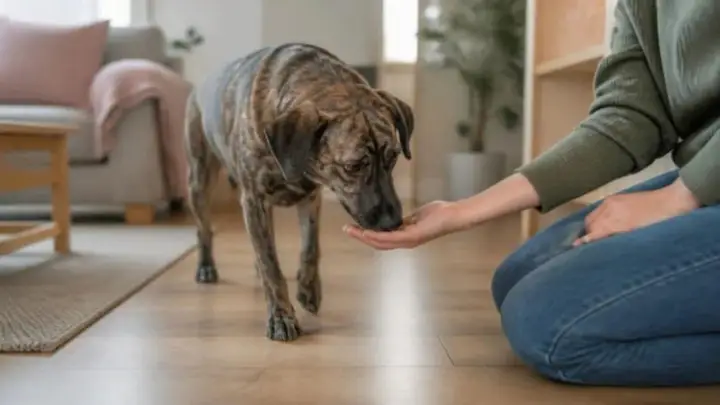
Hand-feeding is a simple, reliable way to build trust. Measure out the day's food and give part of it by hand, a few pieces at a time, while you sit quietly nearby. It costs nothing, and it makes you the source of good things without asking the animal to do anything it is not ready for.
If the animal will not take food from your hand yet, toss pieces a short distance away, then a little closer each day. With a very shy cat, sit in the room and read while it eats. Being present at mealtimes, without staring, still counts.
- Sniff walks: let the dog set a slow pace on a quiet route and sniff as much as it likes. Sniffing helps most dogs unwind.
- Short training sessions: two or three minutes of teaching "sit" or a nose touch to your hand, with food rewards, ending while the animal still wants more.
- Quiet company: settle on the floor with your side toward the animal, and read or look at your phone. Let it come to you.
- Play on its terms: a tug toy for a dog or a wand toy for a cat, stopped before it tips into overexcitement.
Let the animal choose contact
Many of us show affection through touch, and many rescued animals are not ready for it. Hugs, kisses on the head and hands reaching down over the head are among the things most likely to make a nervous dog uneasy. Crouch sideways instead of standing over the animal, offer a hand low down, and let it close the distance.
A simple consent check helps. Stroke the chest or the side of the neck for about three seconds, then stop. If the animal leans in, nudges your hand or stays close, it wants more. If it moves away, shakes itself off or goes still, it has had enough, and respecting that is exactly how trust grows.
Learn the small stress signals too: lip licking, yawning when not tired, showing the whites of the eyes, a tucked tail, turning the head away, or a cat's tail lashing from side to side. These are polite requests for space. An animal whose polite requests are ignored may stop making them and go straight to a growl, a hiss or a snap.
Talk to them
Talk to your new animal, even in the first days. Researchers in Hungary who scanned the brains of awake dogs found that dogs process both the words we say and the tone we say them in. There is more on this in our article on how dogs think.
You do not need special words. A calm, warm voice, used often, becomes one of the familiar things that tells the animal it is safe. Give each daily event its own word, one for meals and another for walks, and say it the same way each time. Within a few weeks, many animals start to predict what comes next.
Cats have their own quiet signal. Try a slow blink: look at the cat with soft eyes, close them slowly and open them again. A relaxed cat will often return it, which makes it a gentle way to say hello without asking for anything.
Progress and setbacks
Many adopters notice a change around the third week. The quiet, careful animal starts testing limits, barking at the door or ignoring things it seemed to know. This is usually a sign of progress. It often means the animal feels safe enough to show its real personality, and now you can start teaching it how your home works. For a week-by-week look at these stages with a small dog, see our guide to the first 30 days with a small rescue dog.
Progress is easy to miss when you see the animal every day. These are some of the signs that trust is growing:
- It comes to see you when you get home, even for a moment.
- It eats normally and falls asleep in the same room as you.
- It sleeps stretched out in the open instead of curled up in a hiding place.
- A dog checks in with you on walks, or looks to you when something startles it.
- It recovers from a fright faster than it did in the first weeks.
- It starts to play, with toys or with you.
There will also be genuinely bad days: a fright on a walk, a visitor who moved too fast, a thunderstorm. Go back a step, keep the routine steady and give the animal time to recover. Punishment of any kind, from shouting to a jerk on the leash, damages trust much faster than kindness builds it. If your dog is frightened of many things, our article on working with a fearful dog goes into more detail.
When to ask for help
Ask your vet to check the animal if its behavior changes suddenly, for example growling when touched in one spot, limping, or snapping when it used to be calm. Pain is a common cause of what looks like bad behavior. If fear or aggression is not improving after several weeks, a qualified behaviorist using reward-based methods can help you build a plan.
If you adopted from us, you do not have to work it out alone. Write to us with any question, however small it seems, and describe what the animal does and when it happens. We stay in touch with the families who adopt from us, and a clear description makes it much easier to suggest something useful.
See also
From our rescues



This article is general information, not veterinary advice. Always consult a veterinarian about your animal’s health. Some pictures in PawPedia may be AI-generated.
This page was last updated on September 30, 2026.