How to Litter Train a Kitten
From PawPedia, an encyclopedia of life with animals
Fact-checked against expert sources
Contents
In short
To litter train a kitten, offer a low-sided box in a quiet spot away from food and water, with fine unscented litter, and place the kitten in it after waking, meals and play. Never punish accidents. See a vet if it strains, cries, or passes little or no urine, since a blocked bladder is an emergency.
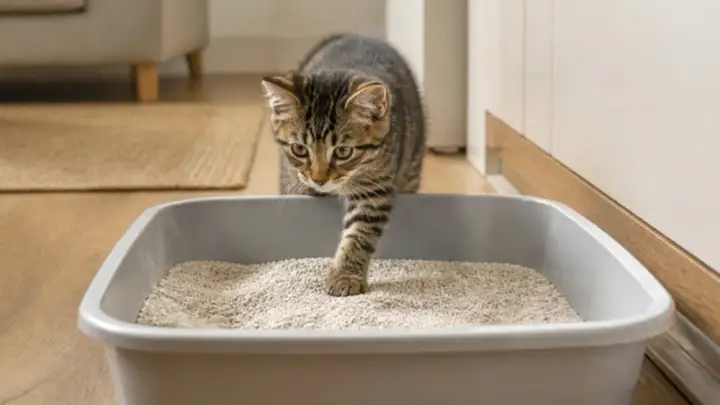
| When it starts | A low-sided tray from around three weeks of age; most kittens toilet by themselves by five to six weeks |
|---|---|
| The box | Low sides or a low entrance, and about one and a half times the cat's length; most cats prefer a box without a cover |
| The litter | Fine, sand-like and unscented; very young kittens do better with sand, wood or paper-based litter, and a shallow layer is enough |
| Where | Somewhere quiet and easy to reach, away from food and water, noisy machines, busy hallways and cat flaps |
| First days | Start in one room, show the box on arrival and place the kitten in it after waking, meals and play |
| Cleaning | Scoop at least once a day, and wash the box with hot water and a mild, unscented detergent |
| Accidents | Common in the first weeks; clean with an enzyme cleaner, find what puts the kitten off and try a second box near the spot |
| Several cats | One box per cat plus one extra, spread around the home rather than lined up in one place |
| Avoid | Punishing the kitten or rubbing its nose in the mess, scented litter, plastic liners, ammonia-based cleaners and holding it in the box |
| See a vet if | Straining or crying in the box, blood in urine or stool, diarrhea or hard stool, lots of genital licking, or new accidents after weeks of good habits |
| Same-day vet | A cat that strains and passes no urine at all, because a blocked bladder is an emergency |
Most kittens learn to use a litter box quickly. Cats have a natural urge to dig in loose material and bury their waste, and a kitten raised by its mother usually learns by watching her. Your job is to make the right spot easy to find and pleasant to use. This guide covers the box, the litter, where to put it, the first days at home, accidents, and how many boxes you need for several cats.
When kittens start using a litter box
Very young kittens cannot pee or poop on their own. In the first weeks of life, the mother cat licks them to trigger it, and a foster carer does the same with a damp cotton ball. International Cat Care advises offering a low-sided tray from around three weeks of age, and says most kittens can toilet for themselves by five to six weeks. Many rescues introduce the box at about four weeks.
Kittens adopted at eight weeks or older usually already use a tray, but a new home is confusing, and a short refresher helps. Orphaned kittens raised by hand need extra help, which is covered in our guide to bottle-feeding orphaned puppies and kittens.
Choosing the box
A kitten needs a box it can climb into easily. Choose one with low sides, or one with a low entrance cut into one side. A small, shallow tray works well at first, but kittens grow fast, so move to a larger box as your kitten grows.
Size matters more than most people expect. International Cat Care suggests a box about one and a half times the length of your cat, measured from the nose to the base of the tail. Many standard boxes are too small for an adult cat. Rectangular boxes usually work better than corner or round ones.
Covered boxes keep litter in, but they trap smells inside, and some cats feel cornered in them. VCA and the ASPCA both note that most cats prefer a simple box without a cover. If you use a covered box, remove the flap door. Self-cleaning boxes can startle young cats, and VCA advises checking the maker's age and weight limits before using one with a kitten.
Choosing the litter
Most cats prefer a fine, sand-like, unscented litter, and many like clumping litter best. Scented litters and deodorizers may smell pleasant to people, but they can put cats off the box. Plastic liners are best skipped too, because claws catch in them.
Very young kittens are a special case, because they often taste and play in their litter. International Cat Care suggests starting with sand, wood or paper-based litter rather than clay, and says silica crystal litter should not be used for kittens under eight weeks. Best Friends Animal Society advises against clumping litter for young kittens, since the dust can clump inside the gut or airways if swallowed or breathed in. Once your kitten has stopped eating litter, you can move to the type you plan to use long term. Change litter gradually, mixing the new type into the old over several days.
A shallow layer of litter is enough. Sources differ a little on depth. The ASPCA and Cornell suggest about 1 to 2 inches (3 to 5 centimeters), while VCA suggests a little more. Start shallow and adjust to what your kitten likes.
Where to put the box
Place the box somewhere quiet and easy to reach, where your kitten can see anyone coming and leave in more than one direction. A calm corner of a bedroom or bathroom often works well. Poor spots include next to a noisy washing machine, in a busy hallway, beside a cat flap, or near a large glass door where outdoor cats can be seen.
Keep the box away from food and water. Cats do not like to eat near their toilet, and a box next to the food bowl is often ignored. Keep dogs and small children away from it as well, using a baby gate if needed. In a house with more than one floor, put a box on each floor.
The first days at home
Start your kitten in one room that has everything it needs: a litter box, food, water, a bed, toys and somewhere to hide. International Cat Care suggests keeping a new kitten in one room for the first few weeks. A small space makes the box easy to find, and the kitten can settle without being overwhelmed. Our guide to caring for a new kitten covers the rest of this setup.
Show your kitten the box as soon as you arrive, and let it sniff and explore. Then help it learn the routine.
- Place your kitten in the box after it wakes up, after meals and after play.
- Watch for sniffing, scratching at the floor, circling or crouching, and gently move your kitten to the box when you see them.
- Let your kitten dig. If it does not, gently scratch the litter with your finger to show it.
- Stay calm and quiet. A kitten that is grabbed or held in the box may start to avoid it.
- Praise softly, or offer a small treat, after your kitten uses the box.
Leaving a little used litter in the box at first can help, because the scent tells the kitten this is the right place. Once your kitten uses the box reliably, let it explore more of the home, one room at a time. VCA advises supervising a kitten, or keeping it in its room, until it uses the box consistently.
Keeping the box clean
A dirty box is one of the most common reasons cats go elsewhere. Scoop out waste at least once a day. International Cat Care recommends at least twice a day. With clumping litter, empty the box fully, wash it and refill it every two to four weeks. Non-clumping litter needs a full change about once a week.
Wash the box with hot water and a mild, unscented detergent, then rinse and dry it well. Avoid strong disinfectants. Some, including those that turn cloudy in water, are toxic to cats.
Accidents and how to handle them
Accidents are common in the first weeks. They are a sign that something in the setup needs changing, not that your kitten is being naughty. Never punish a kitten, shout at it or rub its nose in the mess. Cats do not connect punishment with the mess, and fear often leads them to hide when they toilet, which makes the problem worse.
If you see your kitten starting to go in the wrong place, calmly guide it to the box, but do not chase or carry a frightened kitten. Clean the spot with an enzyme cleaner made for pet urine. Avoid ammonia-based products, because urine contains ammonia and the smell can draw the kitten back. Then look at what might be putting your kitten off.
- Is the box too far away, too small, or hard to climb into?
- Is it dirty, or has the litter changed or become scented?
- Is it in a noisy or busy place, or close to food?
- Has a dog, another cat or a child been bothering the kitten at the box?
- Has your kitten been given too much space too soon?
Putting a second box near the spot where accidents happen often helps. You can also offer two boxes with different litters side by side, and see which one your kitten chooses.
How many boxes for several cats
The usual rule is one box per cat, plus one extra. One cat needs two boxes, and three cats need four. Spread the boxes around the home rather than lining them up in one place. International Cat Care explains that cats see boxes grouped together as a single toilet, and one cat can easily block another from reaching them.
In a home with several cats, watch for tension. A cat that is chased or stared at near the box may stop using it. Boxes in different rooms and on different floors give each cat a safe choice. If your kitten is joining a home with a dog, see how to raise a dog and a cat together.
When to see a vet
Sometimes a kitten or cat avoids the box because something hurts. Cats that link the box with pain may keep avoiding it even after they recover. Contact your vet if you notice any of the following.
- Straining in the box, or many trips with little or no urine
- Crying while trying to pee or poop
- Blood in the urine or stool
- Diarrhea, or very hard stool
- Licking the genital area a lot
- Peeing or pooping outside the box after weeks of good habits
- A tender belly, low energy or poor appetite
A cat that strains and passes no urine at all needs a vet the same day, because a blocked bladder is an emergency. For more on these problems, see why a cat pees outside the litter box and bladder stones and urinary blockage in cats. Diarrhea in a kitten can also point to parasites such as roundworms, so bring a fresh stool sample to the visit.
Rescue kittens
Kittens found outdoors, or raised without a mother, may never have had the chance to learn. Most still pick it up within days once they have a box, a small space and a calm routine. At Paw Squadron, every rescued kitten and cat sees a vet first, for a checkup and deworming, and the first days in care are when good litter habits start to form. If you adopt a rescue kitten, ask which litter it has been using and how it has been doing with the box.
For more guides on settling in a new cat or kitten, browse PawPedia. If you adopted a kitten from us and have questions, write to us from the Contact page.
See also
From our rescues



Sources
Online sources
- How to Litter Train a Kitten · VCA Animal Hospitals
- House Training for Kittens and Cats · VCA Animal Hospitals
- Choosing a litter tray for your cat · International Cat Care
- Helping your new cat or kitten settle in · International Cat Care
- Bringing up a litter of kittens: health considerations · International Cat Care
- Multi-cat households · International Cat Care
- Litter Box Problems · ASPCA
- Feline Behavior Problems: House Soiling · Cornell Feline Health Center
- Weaning foster kittens · Best Friends Animal Society
Encyclopedias
- Litter box · Wikipedia
Books
- Bradshaw JWS, Casey RA, Brown SL. The Behaviour of the Domestic Cat. 2nd ed. Wallingford: CABI, 2012. ISBN 9781845939922
- Peterson ME, Kutzler MA (eds.). Small Animal Pediatrics: The First 12 Months of Life. St. Louis: Saunders Elsevier, 2011. ISBN 9781416048893
- Pryor K. Don't Shoot the Dog! The New Art of Teaching and Training. Rev. ed. New York: Bantam Books, 1999. ISBN 9780553380392
- 水越美奈. 犬と猫の問題行動の予防と対応:動物病院ができる上手な飼い主指導 [Preventing and Managing Behaviour Problems in Dogs and Cats]. 東京: 緑書房, 2018. ISBN 9784895313551
This article is general information, not veterinary advice. Always consult a veterinarian about your animal’s health. Some pictures in PawPedia may be AI-generated.
This page was last updated on November 3, 2026.