Resource Guarding in Dogs: Food, Toys, and Beds
From PawPedia, an encyclopedia of life with animals
Fact-checked against expert sources
Contents
In short
Resource guarding is a dog's natural urge to protect things it values, such as food, chews, toys or a favorite resting spot, from people or other animals. Punishment usually makes it worse. Safe management, trading and gradual desensitization help, and a qualified professional should guide any case involving snaps, bites or children.

| What it is | A dog guarding something it values from people, from running off with a stolen sock to snapping or biting; normal dog behavior, but a problem when aimed at people |
|---|---|
| Guarded items | Food, chews, bones and toys, stolen items, beds, crates, sofas and favorite resting spots, and less often water bowls or a person's attention |
| Early signs | Eating faster, freezing over a toy, standing stiffly over the item, staring hard, carrying the item away or turning the body to block it |
| Later signs | Growling, lifting the lip, snarling, snapping, lunging or biting |
| Why it happens | The dog worries about losing something; experts describe a breakdown in communication, where quiet signals are ignored and the dog says it more loudly next time |
| Avoid | Punishing a growling dog, taking the bowl away mid-meal, prying the mouth open or confronting the dog; punishment confirms the fear and removes the warning |
| Management first | Feed in a quiet spot behind a gate or in a crate, give set meals at set times, feed pets separately and keep tempting items out of reach |
| Trade game | For dogs that do not guard: swap a low-value item for a tasty treat, then give the item back; skip it if your dog already stiffens, growls or snaps |
| Training plan | Desensitization with counterconditioning: toss a better-than-meal treat as you pass the bowl, move closer over days and weeks, and step up only after many relaxed meals (the ASPCA suggests ten) |
| Children | Never approach a dog that is eating, chewing, resting or holding something, never take items from it, and leave training to adults |
| See a vet if | Your dog has snapped, lunged or bitten, guarding is getting worse or spreading, or it started suddenly in an adult dog, which can point to pain or illness; also see a behavior professional |
A dog that stiffens over its bowl, growls when someone walks past its chew, or snaps when moved off the sofa is showing resource guarding. It worries many new owners, and it can lead to bites if it is ignored or handled badly. The good news is that guarding is normal dog behavior, it can usually be managed safely, and many dogs improve with patient, reward-based training.
What resource guarding is
Guarding valuable things is normal for dogs. In a pet dog, though, guarding aimed at people is a problem. It ranges from mild behavior, such as running off with a stolen sock, to serious aggression, such as biting. Dogs can guard almost anything they value.
- Food, from a full bowl to scraps dropped on the floor
- Chews, bones and toys
- Stolen items, such as tissues, food wrappers or socks
- Beds, crates, sofas and favorite resting spots
- Less often, water bowls or a person's attention
Guarding does not mean a dog is bad or trying to dominate the family. Experts describe it as a breakdown in communication. The dog signals 'please do not come closer', people do not notice or do not back off, and the dog learns it has to say it more loudly next time.
Signs to watch for
Guarding usually starts with small signals and builds up when they are ignored. Learn to spot the early ones.
- Eating faster or gulping as someone comes near
- Stopping eating and going still, or freezing over a toy
- Standing stiffly over the bowl or the item
- Staring hard at the person approaching
- Carrying the item away, or turning the body to block it
- Growling, lifting the lip or snarling
- Snapping, lunging or biting
VCA Animal Hospitals points out that dogs quickly learn whether their quiet signals work. If a stare or a freeze is ignored, a dog may skip straight to a lunge or a bite the next time. That is why the subtle signs deserve attention early.
Why punishment backfires
It can feel natural to scold a growling dog or to take the bowl away to show who is in charge. Behavior experts warn against both. Here is why punishment tends to make guarding worse.
- It confirms the fear. The dog guards because it worries about losing something. Grabbing the item proves the worry was right.
- It removes the warning. A dog punished for growling may stop growling, but the worry stays, so the next step can be a bite with little warning.
- It risks a bite. Reaching for a guarded item, prying the mouth open and confronting the dog are common ways people get bitten.
- It makes dogs more defensive. Confrontation, threats and physical punishment raise fear and anxiety, which is the opposite of what a guarding dog needs.
The American Veterinary Society of Animal Behavior recommends reward-based methods for all dog training. It advises against aversive methods, meaning those that rely on force, pain or discomfort, for treating behavior problems. Surveys link aversive training to more aggression and anxiety in dogs, not less.
Taking the bowl away mid-meal to 'test' the dog also backfires, because it teaches the dog that people near the bowl mean loss.
Management first: keep everyone safe
Before any training, prevent the situations that trigger guarding. Every time a dog guards successfully, the habit gets stronger, and every near miss is a risk.
- Feed your dog in a quiet, low-traffic spot, behind a baby gate, in a crate or in a closed room.
- Feed set meals at set times, and pick up the empty bowl afterward.
- Feed pets separately, out of sight of each other.
- Give special chews only when your dog is alone in its own space, or skip them for now.
- Keep tempting items, like shoes, tissues and food wrappers, out of reach.
- If your dog guards the sofa or bed, block access or close the door, and call it off with a treat rather than pushing or lifting it.
- Do not let anyone, including guests, reach for the dog's bowl or toys.
If your dog grabs something dangerous, such as medicine or a cooked bone, do not chase it. Chasing can turn it into a game, and some dogs swallow the item to keep it. Toss a handful of tasty food a short distance away, and calmly pick up the item while the dog eats. If something has already been swallowed, see our guide to Swallowed Objects in Dogs.
Trading: teaching that giving up pays
For puppies and dogs that do not guard, the trade game helps prevent problems. It teaches the dog that letting go of something earns a reward, and usually the item comes back too. The American Kennel Club describes it like this.
- Offer your dog a low-value item, such as a plain toy, and let it take it.
- Hold a tasty treat, such as a piece of chicken, near its nose. Never force the trade.
- When the dog drops the item, say 'yes' and let it eat the treat while you pick up the item.
- Give the item back. Letting go cost the dog nothing.
- Add a cue such as 'trade' just before the dog lets go, then slowly work up to more valuable items.
Never hand back something dangerous, such as spoiled food or a dead animal. And if your dog already stiffens, growls or snaps over things, skip this game and get professional help first. Done wrong, it can make guarding worse.
Desensitization and counterconditioning
For dogs that already guard, the main treatment is desensitization combined with counterconditioning. In plain terms, the dog meets a very mild version of the trigger, such as a person walking past at a distance, paired with something it loves. Over many sessions, a person approaching starts to predict good things instead of loss. A typical food bowl plan, based on advice from VCA and the ASPCA, looks like this.
- Start at a distance where your dog keeps eating calmly, with no stiffening or speeding up.
- As you walk past, toss a treat that is better than the meal so it lands near the bowl, then keep walking.
- Over days and weeks, pass a little closer, as long as your dog stays relaxed.
- Later, drop the treat right into the bowl and walk away.
- Move to the next step only after many relaxed meals in a row. The ASPCA suggests ten.
If your dog stiffens, gulps or growls at any stage, you moved too fast, so go back to an easier step. A baby gate between you and the dog adds safety while you practice. If your dog has already growled, snapped or lunged near its food, VCA advises talking to a behavior professional before you start these exercises. The same approach works for toys, beds and resting spots.
Ask your vet to check your dog too. Pain, illness, weight problems and conditions that increase hunger can all make a dog more irritable and more likely to guard.
Safety with children
Children are at particular risk of being bitten by a guarding dog. They move quickly, reach for things and often miss a dog's warning signs. The ASPCA considers a guarding dog in a home with children a serious risk. These rules help keep everyone safe.
- Children never approach a dog that is eating, chewing, resting or holding something.
- Children never take food, toys or chews from the dog. They fetch an adult instead.
- When children are home, feed the dog and give chews behind a gate or a closed door.
- An adult supervises every interaction, and the dog and young children are kept apart when no adult can watch.
- Only adults do the training exercises. The ASPCA advises that children should not take part.
If your dog has growled at or snapped at a child, keep them apart and get professional help promptly. Our guide to dog aggression covers other triggers and safety steps.
When to get professional help
Mild guarding often improves with management and patient training. Talk to your vet and a qualified behavior professional if any of the following apply.
- Your dog has snapped, lunged or bitten.
- Guarding is getting worse, or spreading to new items, places or people.
- There are children, older adults or visitors who might not follow the rules.
- Guarding started suddenly in an adult dog, which can point to pain or illness.
- You feel unsafe or are not sure where to start.
Look for a veterinary behaviorist, a certified applied animal behaviorist, or a certified trainer experienced with aggression who uses reward-based methods. In some cases, your vet may suggest medication alongside training. Many guarding dogs improve a great deal, though some will always need simple precautions around food or special chews.
Guarding in rescue dogs
Some dogs learn to guard because food was scarce or contested, for example puppies that had to compete with littermates at mealtimes. Guarding seen in a shelter does not always carry over into a new home. A 2013 study found that only about 55 percent of shelter dogs that guarded food during testing did so after adoption. A 2020 study reached similar conclusions and advised shelters not to treat every guarding dog as unadoptable. Some dogs that did not guard in the shelter started to at home, so careful management in the first weeks makes sense for every new dog.
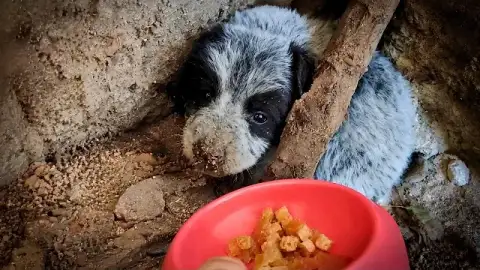
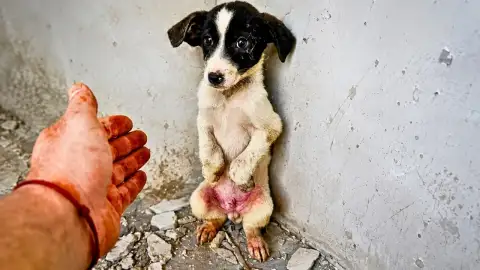
At Paw Squadron, every dog we rescue sees a vet first, with a checkup, deworming and treatment against parasites. Some rescued dogs have lived where food was never guaranteed, and it can take them a while to believe their bowl is safe. Guarding in an adopted dog is not a failure on your part. Manage the situation, ask for help early and give your dog time. A fearful or guarding dog often relaxes as trust grows, as described in Bonding with a Rescue Animal and How to Help a Fearful Dog.
If you adopted your dog from us and it is guarding, write to us from the Contact page and tell us what you are seeing. For more guides on behavior and training, browse PawPedia.
See also
From our rescues
Sources
Online sources
- Food Bowl Aggression in Dogs · VCA Animal Hospitals
- Understanding and Managing Food Aggression in Puppies · VCA Animal Hospitals
- Dog Aggression Toward Family Members: Treatment · VCA Animal Hospitals
- Food Guarding · ASPCA
- Teach Your Dog to Trade Items With You · American Kennel Club
- Position Statement on Humane Dog Training (2021) · American Veterinary Society of Animal Behavior
- Abilities of Canine Shelter Behavioral Evaluations and Owner Surrender Profiles to Predict Resource Guarding in Adoptive Homes (McGuire et al., 2020) · Animals (MDPI), via PubMed Central
Encyclopedias
- Dog behavior § Resource guarding · Wikipedia
Books
- Serpell J (ed.). The Domestic Dog: Its Evolution, Behavior and Interactions with People. 2nd ed. Cambridge: Cambridge University Press, 2017. ISBN 9781107024144
- Сотская М. Н., Мычко Е. Н. Проблемы поведения собак и методы их решения. Биологические основы поведения [Behaviour Problems in Dogs and How to Solve Them: The Biological Basis of Behaviour]. Москва: Аквариум, 2023. ISBN 9785423804015
- 猪熊壽、遠藤秀紀. イヌの動物学 [The Zoology of the Dog]. 第2版. 東京: 東京大学出版会, 2019. ISBN 9784130740234
- Landsberg GM, Hunthausen WL, Ackerman LJ. Behavior Problems of the Dog and Cat. 3rd ed. Edinburgh: Saunders Elsevier, 2012. ISBN 9780702043352
- Miklósi Á. Dog Behaviour, Evolution, and Cognition. 2nd ed. Oxford: Oxford University Press, 2014. ISBN 9780199646661
This article is general information, not veterinary advice. Always consult a veterinarian about your animal’s health. Some pictures in PawPedia may be AI-generated.
This page was last updated on November 11, 2026.