Siberian Husky: Temperament, Exercise, and Care
From PawPedia, an encyclopedia of life with animals
Fact-checked against expert sources
Contents
In short
Siberian Huskies are friendly, gentle sled dogs bred to run long distances. They need a lot of daily exercise, secure confinement because they roam and have a strong prey drive, company for most of the day, and regular brushing, especially when they shed their dense undercoat.
| Origin | Developed by the Chukchi people of northeastern Asia as an endurance sled dog; a purebred domestic dog, not a wolf or a wolf cross |
|---|---|
| Size | Medium; males about 53.5 to 60 cm and 20 to 27 kg, females about 51 to 56 cm and 16 to 23 kg (Australian standard) |
| Lifespan | More than ten years, according to the Royal Kennel Club |
| Coat | Double coat with a soft, dense undercoat and straight guard hairs; the undercoat sheds heavily at least once a year |
| Grooming | More than once a week, and daily during heavy shedding; no trimming, and bathing is rarely needed |
| Temperament | Friendly, gentle and affectionate but not fawning; sociable, independent, not a watchdog, and likely to dig and chew when young |
| Exercise | The highest exercise group, more than two hours a day, ideally work in harness such as canicross or pulling a scooter or sled |
| Escape and prey drive | Famous for slipping out of yards; keep the dog confined or under control, and note that small animals, including cats, can be at risk |
| Heat | A cold-weather breed, but heat is the bigger risk; exercise at the coolest times of day and offer shade and water |
| Common health problems | Juvenile cataracts, corneal dystrophy, X-linked progressive retinal atrophy and zinc-responsive dermatosis around the eyes and mouth |
| See a vet at once if | Heavy panting, drooling, weakness, wobbling or collapse during or after exercise, any injury after an escape, or a sudden painful eye or loss of vision |
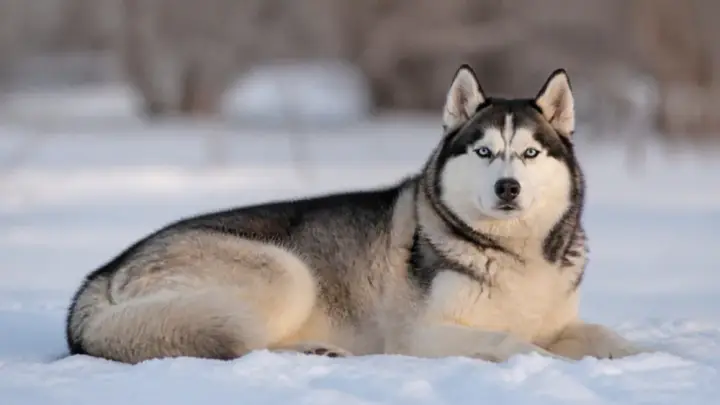
The Siberian Husky is easy to recognize, with its thick coat, upright ears and wolf-like face. Many people choose one for its looks. The breed was shaped for a very specific job, though, and almost everything it needs at home follows from that job. This guide covers the husky's temperament, exercise and grooming needs, the main health problems, and why so many huskies end up in shelters.
Where the breed comes from
The Chukchi people of northeastern Asia developed the Siberian Husky as an endurance sled dog. Its work was to pull a light load at a moderate speed over great distances, usually as part of a team. The breed club in the United States stresses that the husky is a purebred domestic dog, not a wolf or a wolf cross.
It is a medium-sized dog, quick and light on its feet. Under the breed standard used in Australia, males stand about 53.5 to 60 cm (21 to 23.5 inches) at the shoulder and weigh 20 to 27 kg (about 44 to 60 pounds). Females stand 51 to 56 cm (20 to 22 inches) and weigh 16 to 23 kg (about 35 to 50 pounds). The Royal Kennel Club lists a typical lifespan of more than ten years.
Temperament
Huskies are known for a friendly, gentle nature. The breed club describes them as affectionate but not fawning. Most greet visitors warmly, so a husky is not a watchdog, even if its looks put some strangers off. It is also not usually a one-person dog. It tends to like the whole family and many people outside it.
- Sociable: the breed club says huskies need the company of people or other dogs at all times, and advises against the breed for people who are out at work all day.
- Independent: huskies are intelligent and willing, but they have an independent streak that can test your patience during training.
- Diggers and chewers: young huskies often dig holes in the yard and chew. Both can be redirected, but they rarely disappear without effort.
Short, frequent, reward-based training sessions suit most huskies. Harsh corrections tend to damage trust without solving the problem, and a bored, lonely husky is much harder to live with than a tired, content one.
Energy and exercise
The Royal Kennel Club puts the Siberian Husky in its highest exercise group, at more than two hours a day. The breed club describes a strong, built-in desire to run. A walk around the block is not enough for most huskies.
Because huskies should not run loose, exercise needs some planning. The breed club suggests a leash, a large secure enclosure, or, best of all, work in harness. Many owners use harness sports such as canicross, where the dog pulls you while you run, or pulling a scooter or sled. Puzzle feeders, scent games and training sessions add mental work on days when the weather or your schedule limits running.
Huskies are known as easy keepers. For their size, they need a relatively small amount of food, so measure meals and watch your dog's waistline rather than following the bag's top figure.
Escape artistry and prey drive
Huskies are famous for slipping out of yards and running off. The breed club's advice is clear: for its own protection, a husky should be kept confined or under control at all times. A dog that loves to run can cover a long distance quickly, and one dash across a busy road can be fatal.
- Check fences regularly for gaps, weak spots and places where the dog could dig underneath.
- Supervise time in the yard, especially in the first months.
- Keep doors and gates closed, and teach family members and visitors to do the same.
- Use a well-fitted harness or collar and a leash or long line outside a fenced area.
- Make sure your dog is microchipped and wears an ID tag with your current phone number.
The breed club also warns that the husky's predatory instinct is strong. Small animals, including squirrels, rabbits, birds, guinea pigs, hamsters and cats, can be at risk. Some huskies share a home peacefully with a cat they grew up with, but this is never guaranteed. Introductions need to be slow and supervised, as described in How to Raise a Dog and a Cat Together.
Shedding and grooming
The husky has a double coat: a soft, dense undercoat under straight outer guard hairs. At least once a year, the dog sheds its undercoat heavily. The breed club calls this blowing the coat, and it is when you see just how dense the coat really is.
The Royal Kennel Club suggests grooming more than once a week, and daily brushing helps during heavy shedding. The coat does not need trimming, and the breed standard allows only tidying of the whiskers and the fur around the feet. Huskies are naturally clean dogs with little body odor, so frequent bathing is rarely needed. Tools and techniques are covered in Grooming Dogs and Cats at Home. If loose hair on clothes and furniture would bother you, this is not the breed for you.
A true cold-weather breed
The husky's coat was made for work in low temperatures. Even so, a husky still needs a dry, sheltered place to rest, water that has not frozen, and company. Check the paws for ice and salt after winter walks. Our guide to winter safety for dogs covers the warning signs of getting too cold.
Heat is the bigger risk for this breed. A large study of UK dogs found that exercise was the most common trigger of heatstroke, and that dogs under two years old and dogs weighing 10 kg or more had higher odds of it. Many huskies fit both groups. In warm weather, exercise at the coolest times of day, shorten sessions, offer shade and water, and stop at the first sign of struggling. See Heatstroke in Dogs for first aid.
Common health problems
The main inherited problems the breed club monitors are in the eyes.
- Juvenile cataracts: cloudiness in the lens that can appear as early as three months of age and may affect one eye before the other.
- Corneal dystrophy: fatty deposits in the clear front of the eye. It rarely affects vision.
- X-linked progressive retinal atrophy: a gradual loss of night vision, then day vision, that ends in blindness. Males are usually more severely affected, sometimes from about five months of age. A DNA test can identify carriers.
Because eye changes can develop years after a normal exam, the breed club asks breeders to have their dogs examined by a veterinary eye specialist every year they are bred. The Royal Kennel Club also recommends hip scoring for breeding dogs. More about cloudy eyes is in our guide to cataracts in dogs.
Huskies and Alaskan Malamutes can also develop zinc-responsive dermatosis. It causes fine scaling, crusts and redness on the face, mainly around the eyes and mouth. It needs a diagnosis from your vet, so do not add zinc or other supplements on your own.
When to see a vet
Book a vet visit if you notice any of these signs.
- A cloudy or bluish-white look in one or both eyes
- Bumping into things, especially in dim light, or reluctance to go out at dusk
- Squinting, a red eye or discharge
- Scaling, crusts or hair loss around the eyes and mouth
- Limping or stiffness after exercise
Some signs need help the same day or an emergency clinic out of hours.
- Heavy panting, drooling, weakness, wobbling or collapse during or after exercise
- Any injury after an escape, even if your dog seems fine
- A sudden painful eye or sudden loss of vision
Why many huskies end up in shelters
According to the breed club, most huskies come into shelters and rescues as adolescents, between about 9 and 16 months of age. Often their owners never trained them and could no longer manage them. The reasons tend to follow the traits in this guide: a young dog with huge energy, a talent for escaping, a strong prey drive, heavy shedding and a dislike of being left alone.
None of these traits are faults. They are the normal behavior of a working sled dog living in a home that was not ready for it. An adult husky from a rescue can be a good choice, because you can see its energy level, its reaction to cats and its escape habits before you commit. A good rescue will share the dog's veterinary records and an honest account of its behavior and training. Our guide on how to adopt a rescue dog explains what to ask.
At Paw Squadron we rescue dogs and cats, and every animal we take in sees a vet and is dewormed before anything else. A husky or husky mix can be a joyful, loyal partner for an active family that plans for its exercise, fencing and grooming from day one.
For more breed guides and care articles, browse PawPedia. If you have questions about adopting from us, read our FAQ or write to us from the Contact page.
See also
From our rescues

Sources
Online sources
- The Siberian Husky · Siberian Husky Club of America
- So... You Want A Siberian Husky? · Siberian Husky Club of America
- Adopting A Siberian · Siberian Husky Club of America
- Genetic Defects of the Eye · Siberian Husky Club of America
- Siberian Husky breed information · The Royal Kennel Club
- Siberian Husky breed standard · Dogs Australia
- Miscellaneous Systemic Dermatoses in Animals · Merck Veterinary Manual
- Dogs don't die just in hot cars: exertional heat-related illness (heatstroke) is a greater threat to UK dogs · RCVS Knowledge
Encyclopedias
- Siberian Husky · Wikipedia
- Siberian Husky · Encyclopædia Britannica
- Е. М. Шепелёва. Хаски [Siberian Husky] · Большая российская энциклопедия, т. 33, Москва, 2017, с. 786 (archived copy)
- Dog · Encyclopædia Britannica
- А. Ю. Ендукин. Собака [Dog] · Большая российская энциклопедия, т. 30, Москва, 2015, с. 523–524 (archived copy)
- イヌ [Dog] · 日本大百科全書(ニッポニカ), 小学館, via Kotobank
Books
- Fogle B. The New Encyclopedia of the Dog. New York: DK Publishing, 2000. ISBN 9780789461308
- American Kennel Club. The New Complete Dog Book: Official Breed Standards and Profiles for Over 200 Breeds. 22nd ed. Mount Joy, PA: CompanionHouse Books, 2017. ISBN 9781621871736
- Gough A, Thomas A, O'Neill D. Breed Predispositions to Disease in Dogs and Cats. 3rd ed. Hoboken, NJ: Wiley-Blackwell, 2018. ISBN 9781119225546
- Блохин Г. И., Блохина Т. В., Бурова Г. А. и др. Кинология: учебник [Cynology: A Textbook]. Санкт-Петербург: Лань, 2013. ISBN 9785811414444
- 猪熊壽、遠藤秀紀. イヌの動物学 [The Zoology of the Dog]. 第2版. 東京: 東京大学出版会, 2019. ISBN 9784130740234
This article is general information, not veterinary advice. Always consult a veterinarian about your animal’s health. Some pictures in PawPedia may be AI-generated.
This page was last updated on November 7, 2026.