How to Stop a Dog from Barking
From PawPedia, an encyclopedia of life with animals
Contents
- (Top)
- Find out which kind of barking you have
- Alert barking: change what the dog can see and hear
- Demand barking: never let the bark work
- Boredom barking: more work for the nose and the brain
- Barking from fear, and barking when left alone
- What not to use
- When the barking needs outside help
- See also
- From our rescues
| The goal | A dog that barks less, for fewer reasons, and can stop when you ask; never total silence |
|---|---|
| First step | Three or four days of notes on when, where and what happened just before and right after each bark |
| Alert barking | Remove the view with frosted film, a closed curtain or a sofa moved away from the glass |
| Demand barking | Turn away and wait, then reward a couple of seconds of quiet; the bark must never work again, not even once |
| Boredom barking | Give the dog more to do: sniffing walks, scatter feeding, food puzzles, short training sessions and scent games |
| Fear barking | Work at a distance where the dog sees the trigger and still takes a treat, then close the gap over weeks |
| Left alone | Build up time alone in tiny steps, starting with absences so short the dog does not react; involve your vet early |
| Avoid | Bark collars that spray, beep or shock; they do nothing about the reason for the barking |
| Also avoid | Shouting, squirting water and shaking a can of coins |
| Method | Change one thing at a time and keep writing it down |
| See a vet if | The barking is new or has changed suddenly, especially in an older dog |
Barking is how dogs talk, so the goal is never total silence. The goal is a dog that barks less, for fewer reasons, and can stop when you ask. Getting there starts with one awkward fact: barking is not one behavior, and the fix for one kind can make another kind worse.
Find out which kind of barking you have
Before you change anything, spend three or four days taking notes. Each time your dog barks, write down the time, where the dog was, what happened just before and what happened right after. That last part matters most, because whatever follows the bark is often what keeps it going.
Patterns show up quickly. Most barking falls into one of these groups, and many dogs have more than one.
- Alert barking: at the doorbell, footsteps in the hallway, or people and dogs passing the window.
- Demand barking: aimed at you, usually while you eat, talk on the phone or hold the ball.
- Boredom barking: long and repetitive, often when the dog is alone in the yard or has had little to do.
- Fear barking: at strangers, other dogs or unfamiliar objects, often while leaning back or backing away.
- Distress barking: starts soon after you leave, with pacing, whining or scratching at doors.
- Excitement barking: during play, before walks or when favorite people arrive.
Deal with the type that causes the most trouble first, and keep your notes going. Without them, it is very hard to tell whether a plan is working or whether you just had a quiet week.
Alert barking: change what the dog can see and hear
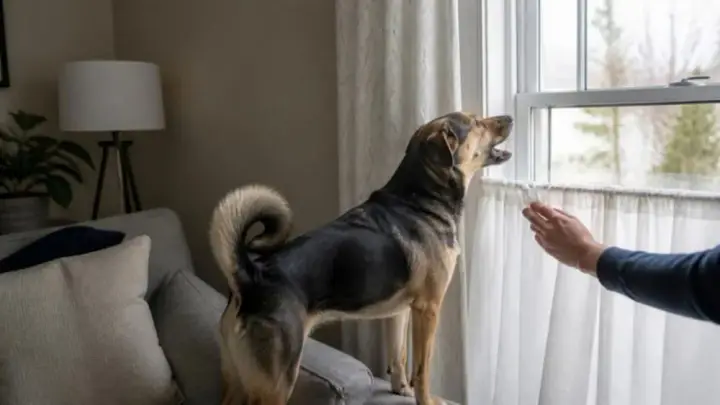
A dog that barks at every passerby is doing a job it has given itself, which is guarding the house. Arguing with the dog does not end that job. Removing the view usually does. Frosted film on the lower part of the window, a closed curtain or a sofa moved away from the glass is an afternoon's work, and it often cuts alert barking sharply.
For sounds, a radio or a fan near the front of the house helps mask footsteps and car doors. When the dog barks once or twice, say a calm word such as "thanks," walk away from the window and reward the dog when it follows you. You have acknowledged the alert and given the dog a better job than shouting at the street.
The doorbell deserves its own plan. Teach the dog to go to a mat or bed a few steps from the door. Practice first with nobody there, then with a family member ringing the bell, and only then with real visitors, keeping a jar of treats near the mat so you can reward quickly.
Yelling at an alert barker rarely helps. To many dogs it sounds as if you have joined in.
Demand barking: never let the bark work
Demand barking is learned. At some point, barking got the dog a treat, a thrown ball, an open door or your attention, and the dog noticed. The fix is simple to describe and hard to live with: the bark must never work again, not even once.
When the dog barks at you, turn away and wait. The moment it has been quiet for a couple of seconds, give it what it wanted if that is something it may have, or another reward it likes. Expect the barking to get louder first. Behaviorists call this an extinction burst, and if you give in at the loudest point, you teach the dog that persistence pays.
Give the dog a polite way to ask as well. A dog that learns that sitting quietly makes the ball fly has little reason to shout. Meeting obvious needs before the dog has to ask, such as a walk at the usual time or dinner before the evening rush, removes many triggers too.
Boredom barking: more work for the nose and the brain
Boredom barking is a symptom of a dog with too little to do. A brisk walk on a short leash along the same sidewalk tires the legs and leaves the brain wanting more. Most dogs also need to sniff, solve small problems and chew. Try adding a few of these to your dog's week.
- A slow sniffing walk where the dog sets the pace and chooses the direction, even for part of the route
- Scatter feeding: toss part of a meal on the grass or a towel and let the dog find every piece
- A food puzzle or a stuffed chew toy for the times the dog is alone
- Two or three training sessions a day of about five minutes each
- Simple scent games, such as hiding treats around one room and letting the dog search
A dog left alone in a yard for hours is a common source of complaints from neighbors. The yard gives it plenty to bark at and nothing else to do. Many dogs are calmer indoors with a chew than outside with a view.
Barking from fear, and barking when left alone
A dog that barks and lunges at other dogs on the leash is often afraid rather than aggressive: it wants more distance, the leash stops it from getting away, and punishment only adds to the fear. Other dogs do the same out of frustration, because they badly want to say hello. In both cases, work at a distance where your dog can see the trigger and still take a treat, then close the gap slowly over weeks, as our guide on how to help a fearful dog explains.
Barking that starts within minutes of you leaving is a different problem. When it comes with howling, pacing, drooling, scratching at doors or accidents in the house, it points to separation-related distress. A dog in that state is anxious rather than naughty, and a quick training tip will not fix it. Set up your phone or a camera the next time you go out, so you can see exactly when the barking starts and what the dog is doing.
The usual approach is to build up time alone in tiny steps, starting with absences so short that the dog does not react. Until then, the dog should not be left alone longer than it can cope with, which may mean help from a friend, a dog sitter or a daycare. Involve your vet early, because some dogs with separation distress only start to make progress once a vet has treated the anxiety as well.
If you are thinking of adopting and work long hours, say so in your adoption inquiry. Dogs differ a lot in how well they handle a day alone, and a good match with your routine prevents much of this barking before it starts.
What not to use
Bark collars that spray, beep or give an electric shock are sold as quick fixes. They may stop the noise for a while, but they do nothing about the reason for it, and an anxious dog punished for barking usually becomes more anxious. Electric collars are banned or restricted in several European countries on welfare grounds.
Shouting, squirting water and shaking a can of coins fall into the same trap. They add stress to a dog that is often stressed already, and they can make the dog wary of you instead of the thing it was barking at.
When the barking needs outside help
Talk to your vet first if the barking is new or has changed suddenly, especially in an older dog. Pain, hearing loss and age-related changes in the brain can all cause barking, and an older dog that barks or wanders at night may be showing signs of cognitive decline. These are medical questions, and training alone will not answer them.
Call a qualified, reward-based trainer or behavior professional if the dog barks and lunges at people, or if distress barking continues despite your plan. The same goes when neighbors have complained and nothing you have tried has helped.
Rescue dogs deserve some extra patience. Many are quiet for their first days in a new home and find their voice a week or two later, as our first-month guide for new adopters describes. Whatever the type of barking, change one thing at a time and keep writing it down, because two weeks of steady work will tell you more than two days of trying everything at once.
See also
From our rescues



This article is general information, not veterinary advice. Always consult a veterinarian about your animal’s health. Some pictures in PawPedia may be AI-generated.
This page was last updated on September 26, 2026.