Bloat (GDV) in Dogs: Signs and Emergency Care
From PawPedia, an encyclopedia of life with animals
Contents
| Also called | Gastric dilatation-volvulus; GDV |
|---|---|
| Cause | Exact cause not fully understood; several factors seem to add up |
| Most at risk | Large and giant dogs with a deep, narrow chest |
| First signs | Retching that brings nothing up |
| Common signs | Drooling, restlessness or pacing, a swollen or drum-tight belly, signs of belly pain, panting or fast breathing |
| Diagnosis | An X-ray of the belly confirms it and shows whether the stomach has twisted |
| Treatment | The vet team first stabilizes the dog, then a surgeon corrects the twist; a twisted stomach cannot be fixed at home |
| Outlook | Often fatal without treatment; with fast veterinary care most dogs survive |
| Prevention | Two or three smaller meals a day can lower the risk, though no habit removes it completely |
| Risk to people | None; it is not an infection and cannot pass to other pets or people |
| Emergency if | Bloat is suspected, day or night: repeated retching with nothing coming up, a swollen belly, pale gums, weakness or collapse |
Bloat is the everyday name for gastric dilatation-volvulus, or GDV. The stomach fills with gas, and sometimes with fluid or food, and swells. In the more dangerous form, the swollen stomach also twists on itself. The twist traps the gas inside and cuts off blood flow to the stomach wall and sometimes to the spleen. The enlarged stomach also presses on large blood vessels in the belly, so less blood returns to the heart and the dog goes into shock.
GDV gets worse quickly. Without treatment it is often fatal, sometimes within hours. With fast veterinary care, most dogs survive. This guide explains the early signs, what to do, how vets treat it, and how you can lower the risk.
Signs to watch for
Signs usually appear suddenly. The most typical early sign is retching that brings nothing up. The dog heaves again and again as if about to vomit, and only a little foamy saliva comes out, or nothing at all. Other signs owners often notice include the following.
- Retching or trying to vomit without bringing up food
- Drooling more than usual
- Restlessness, pacing, or not being able to settle or lie down
- A belly that looks swollen or feels tight like a drum
- Signs of belly pain, such as standing with the front legs stretched out and the chest lowered
- Panting or fast breathing
- Pale gums, weakness, or collapse as the problem gets worse
A swollen belly is not always easy to see, especially in a large dog with a deep chest. Repeated retching with nothing coming up, together with restlessness, is reason enough to call a vet. As shock sets in, the dog may lie down and seem dull, with a fast heartbeat and a weak pulse.
When it is an emergency
Treat suspected bloat as an emergency, day or night. Call the nearest veterinary clinic or emergency hospital, say that you think your dog has bloat, and set off straight away. The call gives the team time to prepare.
Time makes a real difference. Dogs that had signs for more than about six hours before they reached a vet tend to do worse than dogs treated sooner.
A twisted stomach cannot be fixed at home. Home remedies and human medicines will not help and can cost valuable time, so it is best to skip them and drive. Keep your dog as calm and still as you can on the way.
If you have a large dog, it is worth finding out now where your nearest 24-hour emergency clinic is and how long it takes to get there.
How vets diagnose it
The vet will usually suspect bloat from what you describe and from the exam. A fast heart rate, weak pulses, pale gums, and a tight, swollen belly are common findings.
An X-ray of the belly confirms the diagnosis. It shows whether the stomach is only swollen with gas or has also twisted. Simple bloat without a twist is still urgent. The vet may be able to treat it by releasing the gas and will talk with you about next steps. A twisted stomach needs surgery.
Blood tests show how the body is coping with shock. A blood value called lactate can help the vet judge whether part of the stomach wall may be damaged. An ECG checks the heart rhythm, because irregular heartbeats are common with GDV.
How vets treat it
Treatment has two stages. First the team stabilizes the dog, and then the surgeon corrects the twist.
Stabilizing usually means intravenous fluids to treat shock, pain relief, and oxygen if needed. The vet also lets out the trapped gas. Usually a tube is passed down the throat into the stomach. Sometimes a needle is first placed through the skin into the stomach to let some gas out and make it easier to pass the tube.
Once the dog is stable enough, surgery follows. The surgeon turns the stomach back into its normal position and checks the stomach wall and the spleen. Any part that has died from lack of blood flow may need to be removed. The surgeon then attaches the stomach to the inside of the body wall. This step is called a gastropexy, and it greatly lowers the chance of the stomach twisting again. Without it, the stomach twists again in a large share of dogs.
After surgery, dogs stay in the hospital for close monitoring. The team watches the heart rhythm carefully, because irregular heartbeats are common in the first day or two after the operation. The outlook is less good when signs lasted many hours, when part of the stomach or the spleen had to be removed, or when heart rhythm problems appeared before surgery.
Once home, your vet will usually recommend a few weeks of restricted exercise while the incision heals, and two or three smaller meals a day instead of one large one.
Which dogs are most at risk
The exact cause of GDV is still not fully understood. Several factors seem to add up.
Any dog can bloat, including small dogs and mixed breeds. The risk is highest in large and giant dogs with a deep, narrow chest. Breeds often mentioned include the Great Dane, German Shepherd, Saint Bernard, Weimaraner, Irish Setter, Gordon Setter, Standard Poodle, Doberman Pinscher, and Basset Hound. Other factors that raise the risk include the following.
- Getting older
- A parent, brother, or sister that had GDV
- Eating one large meal a day
- Eating very fast
- Eating from a raised bowl
- An anxious or fearful temperament, or a stressful event
- Hard exercise soon after eating
- Being on the thin side
- Having had the spleen removed in the past
How to lower the risk
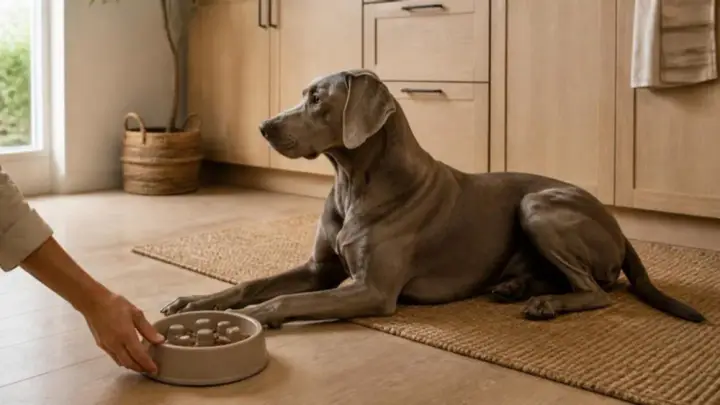
A few everyday habits can lower the risk, though none of them removes it completely. Split the daily food into two or three smaller meals. If your dog gulps food, a slow-feeder bowl or a puzzle feeder can slow the pace. Feed from a bowl on the floor unless your vet advises a raised bowl for another health reason. Keep hard exercise and rough play away from mealtimes, and ask your vet how long to wait.
A calm mealtime also helps. Feed in a quiet spot, and feed pets apart if they compete for food.
For dogs at high risk, many veterinary surgeons recommend a preventive gastropexy. The stomach is attached to the body wall before any problem happens. It is often done at the same time as spaying or neutering. It can also be done on its own, and a minimally invasive technique through small incisions is one option. Ask your vet whether it makes sense for your dog.
A gastropexy does not stop the stomach from filling with gas, so a dog that has had one can still bloat. It makes the dangerous twist much less likely. Any signs of bloat still call for a vet visit straight away.
It does not spread to other pets
GDV is a mechanical problem of the stomach. It is not caused by an infection, so it cannot pass to other pets or to people. The tendency can run in families, which is why a dog with an affected parent or sibling carries a higher risk.
Rescued and newly adopted dogs
With a rescued dog, the family history is often unknown, so you may not know whether any relatives had bloat. Body shape is a useful guide. If your new dog is large with a deep chest, ask your vet about the risk and whether a preventive gastropexy is worth considering.
At Paw Squadron, the first stops after every rescue are the vet and a bath, with a checkup, deworming, and treatment against fleas and other parasites. Every animal gets a checkup, treatment, vaccinations, and a microchip before adoption. These steps cannot predict bloat, which can happen at any age, so it helps to know the signs from the first day.
The first weeks in a new home bring a lot of change, and stress is one of the risk factors vets list. A regular routine, a quiet feeding spot, and meals kept apart from other pets can make mealtimes calmer.
If you have questions about a dog you are thinking of adopting, send us an adoption inquiry. You can find more guides on emergencies and everyday care in PawPedia.
See also
From our rescues
 13:39Abandoned Puppy was Terrified and Freezing during a Massive Rainstorm until This HappenedEmma Storm · February 23, 2022
 12:28Rescue of a Lonely Puppy Nobody Cared ForCarrie Undercart · February 19, 2022
 12:26Abandoned Puppy Was Freezing To Death and Barely Surviving until This HappenedPalm Holland · February 12, 2022
This article is general information, not veterinary advice. Always consult a veterinarian about your animal’s health. Some pictures in PawPedia may be AI-generated.
This page was last updated on October 21, 2026.