Hip Dysplasia in Dogs: Signs, Treatment, and Daily Care
From PawPedia, an encyclopedia of life with animals
Contents
In short
Hip dysplasia is a joint problem in which a dog's hip does not form properly as a puppy grows, so the loose joint wears down and causes arthritis. Many dogs stay comfortable with weight control, gentle exercise, and vet-prescribed pain relief. See a vet for stiffness or bunny-hopping, and the same day if a back leg suddenly bears no weight.
| Cause | Genes are the biggest single risk factor; it runs in families |
|---|---|
| Affects | The hip joint, which wears unevenly and over time leads to arthritis and pain |
| Most at risk | Large and giant breeds; large mixed-breed dogs can have it too |
| Usual age | Many dogs first show signs between one and two years; some at a few months or later in life |
| Risk to people | None; it is not contagious and cannot pass to other dogs, cats or people |
| Common signs | Stiffness getting up, limping on one or both back legs, a bunny-hopping run, a swaying walk and trouble with stairs or jumping |
| Diagnosis | X-rays confirm it and show how much arthritis is present |
| Treatment | Many dogs are managed without surgery: a vet's plan of weight control, gentle exercise and vet-prescribed pain medicine |
| Outlook | With good care, many dogs stay comfortable and active for years |
| Prevention | For puppies, vets recommend a large-breed puppy diet in measured meals and keeping the puppy slim |
| Emergency if | A back leg suddenly carries no weight, or the dog cries out, cannot stand or drags the back legs |
Hip dysplasia is one of the most common joint problems in dogs. It happens when the hip joint does not form properly as a puppy grows. The loose joint wears unevenly, and over time this leads to arthritis and pain.
It is most common in large and giant breeds, such as German Shepherds, Labrador and Golden Retrievers, Rottweilers, and Saint Bernards. Large mixed-breed dogs can have it too. Small dogs are affected less often. With good care, many dogs with hip dysplasia stay comfortable and active for years.
What happens in the hip
The hip is a ball-and-socket joint. The ball is the top of the thigh bone, and the socket is part of the pelvis. In a healthy hip, the ball sits snugly in the socket. In a dysplastic hip, the two parts do not develop in step with each other, so the joint is loose.
A newborn puppy's hips look normal. The problem develops during growth. With every step, the loose joint puts uneven pressure on the cartilage that lines it. The cartilage wears down, the bone underneath changes shape, and small bony spurs form. This is osteoarthritis, and it usually gets worse slowly over the years.
Signs do not always match what X-rays show. Some dogs with badly shaped hips move well for years. Others with milder changes are clearly sore.
Why some dogs develop it
Genes are the biggest single risk factor. Hip dysplasia runs in families, and many genes seem to be involved. This is why a dog with good hips can still have puppies that develop it. How a puppy grows also matters. Eating too much and growing too fast raise the risk. In one well-known study, puppies fed as much as they wanted developed hip dysplasia about twice as often as puppies fed measured meals. Extra body weight adds strain to a loose joint, and weak hip muscles give it less support. The type of exercise a puppy gets in the first months of life plays a part as well.
Hip dysplasia is not contagious. It cannot pass to other dogs, cats, or people. The risk is passed down from parents to puppies, which is why vets advise against breeding dogs with poor hips or a family history of the condition.
Signs to watch for
Some puppies show signs at a few months old. Many dogs first show them between one and two years of age, and others only when arthritis sets in later in life. Common signs include:
- Stiffness or slowness getting up, especially after rest
- Limping on one or both back legs, often worse after exercise
- A "bunny-hopping" run, with both back legs moving together
- A swaying or wobbly walk at the back end
- Trouble with stairs or jumping into the car or onto furniture
- Shorter walks, more time lying down, and less interest in play
- Thinner thigh muscles, while the shoulders carry more of the weight
- Sensitivity when the hips are touched, or a grating feel in the joint as the dog moves
Knee injuries, spine problems, and other joint diseases can look similar, so a vet exam is needed to tell them apart.
When it is an emergency
Hip dysplasia usually changes slowly. Sudden changes are a reason to see a vet the same day. This includes a back leg that suddenly carries no weight, crying out in pain, being unable to stand, or dragging the back legs. Dogs with hip dysplasia are more likely to dislocate a hip. Sudden weakness in both back legs can also point to a spine problem that needs urgent care.
Please do not give your dog human pain medicine while you wait. Some common ones are toxic to dogs.
How vets diagnose it
The vet will usually watch your dog walk and sit, then feel the hips and legs. They check for pain, muscle loss, reduced movement, and looseness in the joint. In young puppies, a hands-on test can show whether the ball slips in and out of the socket.
X-rays confirm the diagnosis and show how much arthritis is present. Most dogs need sedation or a short anesthetic so the hips can be positioned correctly and without pain. The changes are graded from mild to severe. Some vets are trained in a special X-ray method that measures hip looseness in puppies from 16 weeks of age and helps predict the risk of arthritis later. Official hip scores for breeding dogs are given only once the dog is an adult.
How it is treated
Many dogs are managed without surgery. The aim is to control pain, keep the dog moving, and slow the arthritis. Your vet will suggest a plan based on your dog's age, size, how severe the changes are, and how your dog copes day to day.
Vets often call weight control the most effective and least costly long-term step. Regular, gentle exercise keeps the hip muscles strong. Physical therapy, including exercises in water, can improve comfort and movement. Vets often prescribe anti-inflammatory pain medicine made for dogs, and may add other pain medicine if needed. Dogs on long-term medicine usually need regular blood tests to check the liver and kidneys. Some vets also suggest omega-3 fatty acids or joint supplements. The evidence is stronger for omega-3s than for many other joint products, so it is best to ask your vet before buying anything.
Surgery may be an option when a young dog is diagnosed early, or when medical care is no longer enough. The main types are:
- In young puppies, usually before about 4 to 5 months of age, a small procedure changes how the pelvis grows so the socket covers the ball better.
- In young dogs, usually under about 8 to 10 months and before arthritis sets in, the pelvis can be cut and turned to improve the fit.
- In adult dogs, the whole hip can be replaced with an artificial joint. This often gives the most normal movement and is done by specialist surgeons.
- The ball of the thigh bone can be removed so a firm scar-tissue joint forms. This tends to work best in smaller, lighter dogs, and recovery depends a lot on physical therapy afterward.
Your vet can tell you whether a referral to a veterinary surgeon makes sense for your dog.
Daily care at home
A slim body puts less strain on sore hips. You should be able to feel the ribs easily under a thin layer of fat. Ask your vet for a target weight and a daily food amount.
Steady, low-impact exercise is usually best. Several short leash walks are often easier on the hips than one long outing. Swimming can be a good option. It helps to limit repeated jumping, rough play, and ball chasing on hard ground, especially on sore days. Try to keep activity similar from day to day.
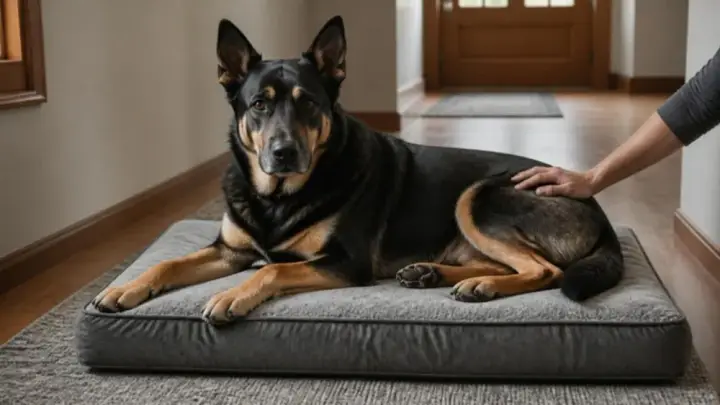
Non-slip rugs on smooth floors, short nails, and a ramp for the car all make moving easier. A thick, supportive bed that is easy to step onto helps sore joints. A baby gate can block the stairs when no one is around to help.
Watch how your dog moves over time. Note changes in stiffness, walking distance, or interest in play, and share them with your vet at checkups. The care plan often needs adjusting as a dog gets older.
Puppies and newly adopted dogs
Good habits in puppyhood help the hips develop as well as possible. Vets recommend a diet made for large-breed puppies, fed in measured meals, and keeping the puppy slim. Adding calcium or vitamin D to a growing puppy's diet is not advised unless your vet finds a medical reason. Outdoor play on soft, uneven ground such as grass is good for a young puppy. One study of large-breed puppies found that off-leash exercise in the first three months lowered the risk, while using stairs in the same period raised it. Long runs, forced exercise, and repeated jumping are best avoided while the puppy is growing. It is also worth asking your vet about the best age to spay or neuter a large-breed puppy, since timing may affect joint health in some dogs.
If a puppy is from a high-risk breed or already shows signs, your vet may suggest early hip screening. Checking before about 20 weeks of age leaves time for an early procedure, if one is needed.
Many rescued dogs are mixed breeds with unknown parents, so there is no family hip history to go on. At Paw Squadron, every animal gets a checkup, treatment, vaccinations, and a microchip before adoption. A general checkup does not always include hip X-rays, and some signs only appear as a young dog grows or settles into a more active life. If your new dog seems stiff, hops when running, or avoids stairs, mention it to your vet early. Dogs that arrived thin can also gain too much once they settle in, so it helps to ask your vet what a healthy weight looks like.
If you are thinking about adopting a large dog or have questions about one you already adopted, see our FAQ or browse more guides in PawPedia.
See also
From our rescues



This article is general information, not veterinary advice. Always consult a veterinarian about your animal’s health. Some pictures in PawPedia may be AI-generated.
This page was last updated on October 1, 2026.